Last updated October 31, 2026
 Water damage drying
 Fire & smoke cleanup
 Mold remediation
 Storm response
 Sewage cleanup
 Reconstruction
Free visual inspection and a written scope of work before any mitigation begins - photos, moisture readings, and drying logs go in your claim file
The scope we write is the scope we bill. Anything new gets shown to you, in writing, before we touch it.
Get your free estimateDIY vs Professional Damage Restoration: The Buena Park Homeowner’s Decision Guide
Every year in Buena Park, a homeowner runs a fan on a wet carpet for three days, declares victory, and then spends the next six months wondering why the baseboard is staining and the hallway smells like a damp basement. The uncomfortable truth is that visible dryness on a surface tells you almost nothing about what’s happening behind the drywall, under the pad, or inside a wall cavity. This guide maps exactly where DIY restoration makes sense, where it becomes a hidden liability, and what Buena Park’s climate and housing stock mean for that decision. For more guides & resources, visit our blog. You’ll learn the three conditions that make DIY defensible, why the equipment gap matters more than effort, and how documentation separates a real restoration from a surface patch.
Quick Answer
DIY restoration is defensible only when three conditions hold at once: the water is Category 1 (clean, from a supply line or rainwater), the affected area is under 10 square feet, and no water has penetrated wall or floor cavities. Everything else, including any amount of Category 2 or 3 water, any cavity penetration, or any visible mold growth beyond a small surface patch, requires professional equipment and documentation. In Buena Park’s semi-arid climate, surface drying happens fast, which makes hidden cavity moisture the most common source of repeat mold problems we see.
Restoration work we handle
Table of Contents
- The Three Conditions Where DIY Is Defensible
- The Equipment Gap: What Rental Machines Actually Do
- Understanding Water Categories: The Decision You’re Really Making
- California Health Code and DIY Liability
- The Documentation Gap: Insurance and Resale Problems
- The Partial-DIY Model: What You Can Legitimately Handle
- Buena Park-Specific Factors: Climate, Housing Stock, and Timing
- Common Mistakes to Avoid
The Three Conditions Where DIY Is Defensible
Before you buy a fan or rent a machine, you need to verify three things. Miss any one of them and the math changes from a weekend project to a structural drying job. Here’s what each condition actually means and how to check it before starting.
Condition one: The water is Category 1. This means clean water from a potable source, a supply line, a faucet left running, rainwater before it hits a floor, or an overflowing tub with no soap or waste in it. If the water came from a dishwasher, washing machine, toilet that overflowed with waste, or any outside source that crossed soil or a roof, you’re in Category 2 or 3 territory. Category 1 water becomes Category 2 within 48 to 72 hours as bacteria multiplies, so the clock starts the moment the water hits the surface.
Condition two: The affected area is under 10 square feet. Ten square feet is roughly a 3-by-3-foot section of floor or a single wall segment. It’s smaller than most people picture. A toilet overflow that spread across a bathroom floor and into the hallway has already exceeded this. The 10-square-foot limit exists because below that threshold, the total moisture load is small enough that a residential dehumidifier and aggressive air movement can realistically remove it within 48 hours. Above it, the drying time extends beyond the window where mold stays dormant.
Condition three: Nothing penetrated a cavity. Water that stays on a hard surface, like tile or sealed concrete, and gets extracted and dried quickly is fundamentally different from water that seeps under baseboards, behind drywall, into subfloor, or into wall cavities. Once water enters a cavity, the drying equation changes entirely. Cavity moisture doesn’t evaporate on its own quickly because there’s no airflow inside the wall. It sits there, against wood and paper-backed drywall, at exactly the temperature and humidity mold needs. Checking for cavity penetration requires pulling back a corner of carpet, removing a baseboard, or using a moisture meter. If you can’t verify it, assume it happened.
Buena Park homes built in the 1950s through 1970s, which account for a large portion of the city’s housing stock, often have plaster-over-gypsum walls with no vapor barrier. Water enters those cavities easily and dries slowly, even in our dry climate. If you have one of these older homes, condition three deserves extra scrutiny.
If all three conditions hold, a DIY approach with a rental dehumidifier, several high-velocity fans, and thorough extraction can work. If any condition fails, surface drying is cosmetic.
The Equipment Gap: What Rental Machines Actually Do
The most common mistake we see in Buena Park isn’t a lack of effort. It’s a homeowner working hard with equipment that was never designed for structural drying. The difference between what you rent at a big-box store and what a restoration company runs is not a matter of degree. It’s a different class of machine.
A typical residential dehumidifier removes about 20 to 30 pints of water per day under ideal conditions. In a cool, humid room, that number drops fast. A commercial low-grain refrigerant (LGR) dehumidifier, like the Dri-Eaz and Phoenix units we run, removes 100 to 140 pints per day and keeps working efficiently at lower humidity levels and lower temperatures. A whole-class of desiccant dehumidifiers removes even more. The gap matters because the timeline matters. Carpet pad, drywall, and wood framing need to drop below 16% moisture content within 48 to 72 hours to prevent mold activation. A residential unit simply cannot pull water out of building materials that fast in most cases.
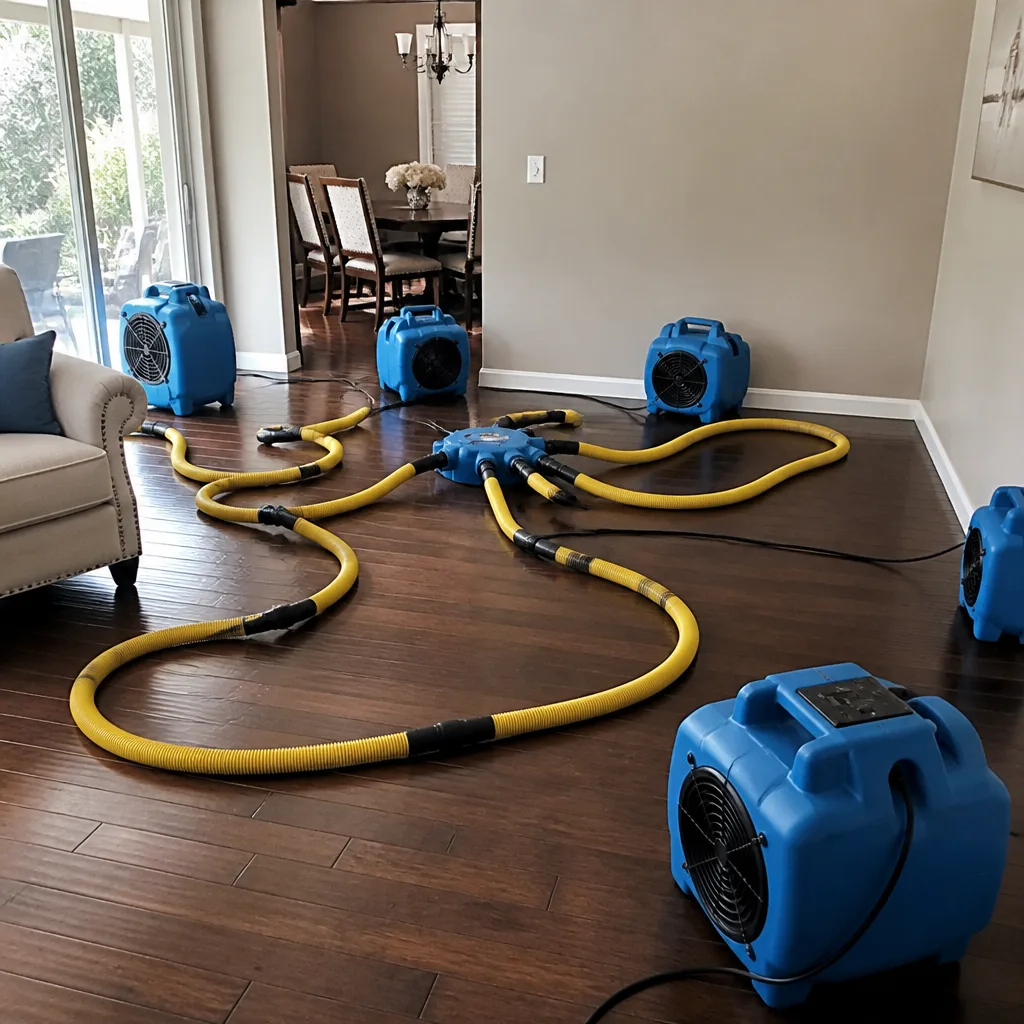
Air movement tells a similar story. A box fan from a hardware store moves air, but it doesn’t create the focused, high-velocity airflow at the surface boundary layer that evaporates water efficiently. Commercial air movers, like the XPOWER and B-Air units we use, move between 2,500 and 4,000 cubic feet per minute and are positioned to create a specific airflow pattern across wet surfaces. The difference shows up in drying time and in the uniformity of the dry-down.
Then there’s the Injectidry system, which has no residential equivalent. It pushes dry air directly into wall cavities, under cabinets, and underneath built-in fixtures through small inlet ports. That’s how a certified team dries the inside of a wall without cutting it open. If water is in a cavity and you don’t have cavity-drying capability, you’re either waiting weeks for it to dry naturally, which will not happen before mold grows, or you’re tearing the wall open, which creates a reconstruction job.
We’re not saying rental equipment has no place. For small, fully verified Category 1 spills on hard surfaces, a rental dehumidifier and a few fans are adequate. The issue is when homeowners extrapolate from that scenario to anything bigger or deeper. The equipment gap is real, and it’s measured in gallons per day and hours to dry, not in effort.
Understanding Water Categories: The Decision You’re Really Making
Every water-damage decision traces back to the water category. This is not an industry nicety. It’s the framework that determines whether you can safely handle the cleanup yourself or whether you’re dealing with a biohazard situation that carries real health and legal consequences.
Category 1: Clean water. This comes from a supply line, a faucet, a shower head, or rainwater before it touches anything contaminated. Category 1 water on a hard, non-porous surface that gets extracted and dried within 48 hours is the DIY zone. The risk is letting it sit long enough to degrade into Category 2, which happens faster in warm weather, which Buena Park has most of the year.
Category 2: Gray water. This is water with significant contamination. Dishwasher discharge, washing machine overflow with detergent, toilet overflow with urine but no feces, aquarium water, or water that has passed through a wet area long enough to pick up bacteria. Category 2 water means you’re dealing with microbial growth potential. Every porous material it touches, carpet, pad, drywall, insulation, needs either professional sanitation or removal. DIY extraction with a wet vac doesn’t address the contamination. If a Buena Park homeowner dries category 2 water without sanitizing or removing affected materials, they’ve created a hidden mold and bacteria condition inside their wall cavities.
Category 3: Black water. This is sewage, floodwater, groundwater, or any water containing fecal matter, pathogens, or toxic substances. Category 3 water is a biohazard. Any porous material it touches is a loss. Non-porous surfaces need hospital-grade disinfection. There is no defensible DIY category 3 restoration. The health risk alone, not to mention the legal and insurance implications, makes professional handling mandatory. If you have a sewage backup in a Buena Park slab foundation home, the water is not just on the surface. It has flowed through the slab channels and under flooring.
Here’s the part competitors skip: a water category is not fixed at the moment of the leak. Category 1 water degrades to Category 2 as microorganisms multiply. That’s the 48-to-72-hour window. A clean-water supply line leak that sat over a weekend while you were away has already degraded by the time you find it. The category at discovery, not at origin, is what matters.
California Health Code and DIY Liability
This is the section where DIY restoration stops being a personal choice and starts being a legal one. California law treats mold and Category 2 or 3 water contamination as health hazards, and the state’s Department of Public Health has published guidance on mold remediation that effectively sets a standard of care. The Toxic Mold Protection Act, while unevenly enforced, created the framework that now governs how mold conditions in rental properties and homes must be addressed.
If you’re a homeowner remediating your own Category 2 water damage and a family member, tenant, or future occupant develops respiratory illness, you carry the liability. If you’re a landlord in Buena Park with a rental property, you have a legal duty to maintain habitable conditions, which includes addressing water damage and mold. A DIY approach that fails to document the contamination category, the drying process, and the final moisture readings exposes you to habitability claims, withholding of rent, and personal injury lawsuits.
The phrase “I didn’t know there was a problem in the wall” doesn’t protect you if a reasonable professional inspection would have found it. Courts and insurance arbitrators use the standard of what a trained professional would have done. When the other side brings in an IICRC-certified expert who testifies that the moisture mapping would have identified cavity saturation, your defense collapses.
We’ve seen this play out in Buena Park and throughout Orange County. A tenant reports a persistent cough. A doctor’s note links it to mold exposure. The landlord remembers the toilet overflow from six months ago that seemed to dry fine. The wall gets opened, the framing is black, and now the landlord is paying for remediation, relocation, medical costs, and legal fees. The cost of a professional drying job at the time of the incident would have been a fraction.
The liability math is simple. Professional restoration produces a documented chain of evidence: moisture readings, drying logs, clearance testing. DIY produces nothing. When a dispute arises, one party has a file and the other has a memory.
The Documentation Gap: Insurance and Resale Problems
Insurance adjusters don’t trust memories. They trust numbers, readings, and reports. A professional restoration generates a documentation package that a homeowner simply cannot produce: initial moisture mapping showing where the water went, daily psychrometric logs tracking temperature, humidity, and moisture content through the drying process, and a final clearance report confirming the structure reached the target moisture levels. These records follow IICRC S500 standards for water damage and S520 standards for mold remediation, which are the benchmarks insurance companies use.
When you file a claim, the adjuster’s first question is what proof you have of the damage and the drying. Photos help, but they don’t show moisture content inside a wall. Without documentation, the adjuster has room to argue that the damage was pre-existing, that the drying was inadequate, or that any secondary mold growth was a maintenance failure rather than a covered loss. A professional report closes those arguments before they open.
Resale creates a second documentation problem. California law requires sellers to disclose known material defects, including water damage and mold. If you DIY-dried a Category 2 event and sold the home without disclosing a hidden mold condition that later surfaces, you’re exposed. If a buyer’s inspector finds moisture or mold that traces back to your DIY restoration, the transaction can collapse or come back on you post-sale. A professional clearance report is a document you can hand to a buyer’s agent that says the home was dried to standard and cleared. That’s a selling point, not a liability.
For rental property owners in Buena Park, documentation is also your defense in a habitability dispute. It shows due diligence. It shows the problem was addressed to an industry standard, not just wiped down and painted over.
The Partial-DIY Model: What You Can Legitimately Handle
The honest answer to the DIY-versus-professional question is not binary. There’s a meaningful set of tasks a homeowner can handle successfully before a certified team arrives, and doing them well reduces both the damage and the final bill. The key is knowing where the line is.
Step 1: Stop the source. Shut off the supply valve, turn off the water main, or turn off the breaker to the affected appliance. If it’s a roof leak, put a tarp up if you can do so safely. Every minute the water keeps flowing adds square footage. This is the single most valuable thing you can do.
Step 2: Remove contents from the wet area. Get furniture, rugs, boxes, electronics, and personal items off the wet floor and onto dry surfaces or outside. Separate anything already wet from anything still dry. Wet contents that can be washed and dried should be. Wet paper, cardboard, and upholstered items that soaked through may be losses, but moving them out prevents secondary damage to the structure.
Step 3: Extract what you can safely reach. If you have a wet/dry shop vac and the water is on a hard surface, extract as much as you can. On carpet, a shop vac helps but won’t get the pad underneath. Don’t walk on saturated carpet more than necessary; you’re pressing water deeper into the pad and subfloor.
Step 4: Stop. This is the part homeowners miss. After extraction, the drying requires measurement. If the affected area exceeds the three conditions we covered earlier, if there’s any chance of cavity penetration, if the water was Category 2 or 3, call a professional before the 48-hour degradation window closes. In Buena Park’s warm climate, that window can be shorter in summer months when interior temperatures stay above 75 degrees.
We’ve seen the partial-DIY model work well. A homeowner in the Buena Park neighborhood near Knott’s Berry Farm shut off a supply line, moved his furniture, extracted the standing water from his tile floor, and called us before the water had time to reach the drywall. The final drying job was smaller, faster, and cheaper because he’d done the right things first. The partial-DIY model failed when a homeowner near the Buena Park Downtown mall used a rental dehumidifier for four days on a Category 2 washer overflow, then called us when the smell returned. By then, the wall cavity was colonized and the job had grown from drying to mold remediation.
Buena Park-Specific Factors: Climate, Housing Stock, and Timing
Restoration advice that’s generic to the country misses what makes Buena Park different. The city’s semi-arid climate, its housing stock, and its geography all shape how water damage behaves here and what a homeowner should do about it.
The climate paradox. Buena Park’s low humidity works against you in a subtle way. When indoor air is dry, surface evaporation happens quickly. A wet tile floor will look dry within hours. That creates false confidence. The moisture that matters, inside wall cavities, under flooring, inside subfloor, doesn’t evaporate quickly because there’s no airflow there, regardless of how dry the room air is. Buena Park homeowners are actually more likely to underestimate cavity moisture because the visible surfaces dry so convincingly.
The slab foundation factor. A significant portion of Buena Park’s single-family homes sit on concrete slab foundations, particularly the post-war tract housing that defines much of the city. Slab foundations mean water from a supply-line leak can travel under flooring, into vinyl, laminate, or carpet pad, without ever being visible from below. A raised foundation lets you look in the crawl space and see the leak. Slab homes hide it. That makes professional moisture mapping more important in Buena Park, not less.
The age of the housing stock. Buena Park experienced its major residential build-out between the 1950s and 1980s. Homes from that era often have no vapor barriers, minimal insulation, and framing that has been through decades of minor moisture events. Older framing absorbs water faster and holds it longer than newer engineered lumber. A leak that would be a minor issue in a 2015 build can become a structural drying job in a 1965 home.
Timing and the degradation window. Buena Park’s summer temperatures routinely push interior temperatures past 80 degrees in homes without air conditioning running. Mold growth accelerates at temperatures above 70 degrees, and bacterial growth in standing water accelerates with heat. The standard 48-to-72-hour window for Category 1 to degrade to Category 2 assumes moderate temperatures. In a Buena Park summer with the AC off, that window can compress to 24 to 48 hours. Response time matters more here than it would in a cooler coastal climate.
These factors don’t change the fundamental DIY-versus-professional decision framework. They tighten it. In Buena Park, the margin for error on a DIY drying job is smaller than in most of the country, because the climate hides the problem while the housing stock stores it.
Common Mistakes to Avoid
- Trusting visual dryness. Drywall and carpet can be dry to the touch on the surface while the back side and the framing behind them are saturated. In Buena Park’s dry air, this happens fast. You need a moisture meter to know what’s actually dry, not your fingertips.
- Using only a residential dehumidifier. A retail dehumidifier pulling 25 pints a day cannot dry saturated building materials within the mold-prevention window. The machine runs for days, the bill is modest, and the wall cavity is still wet in week two.
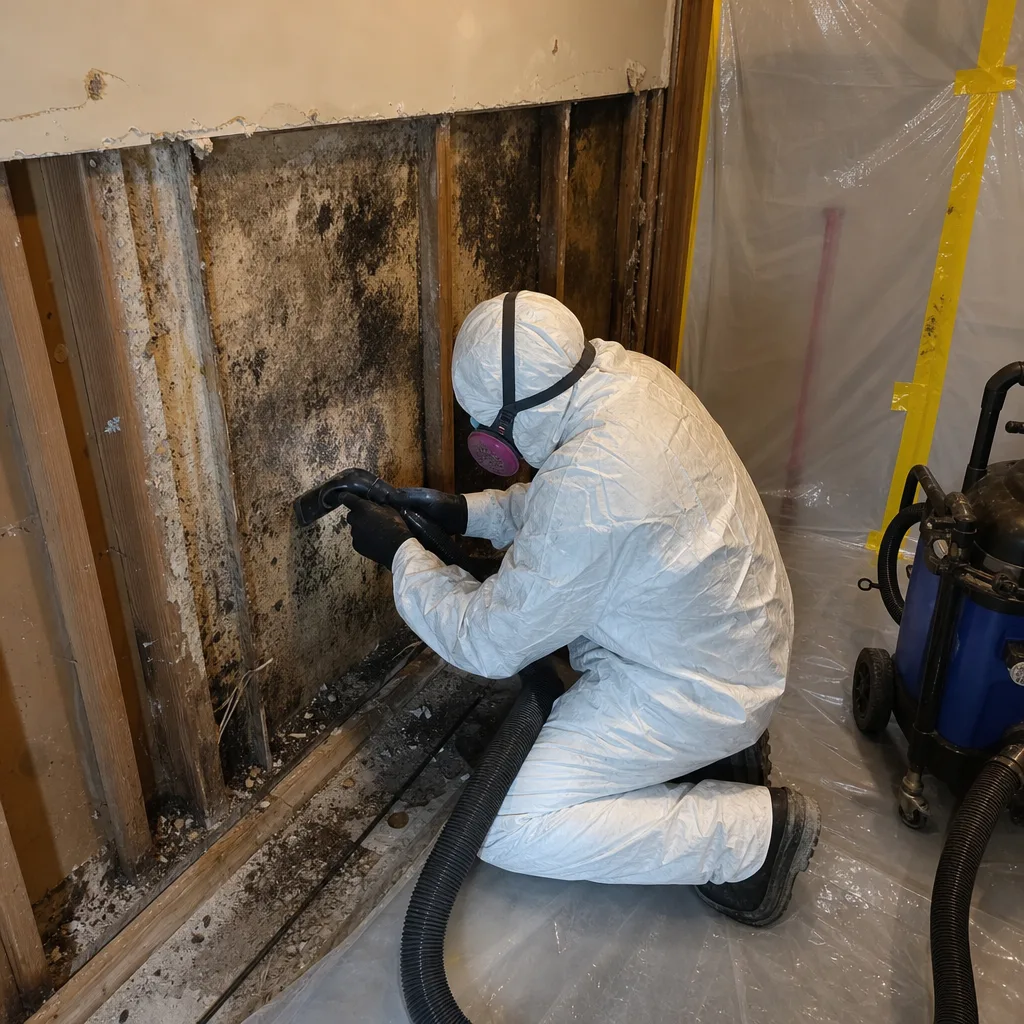
- Skipping the containment barrier. If you’re doing any demolition or cleaning on Category 2 or 3 water or on visible mold, failing to seal the work area lets spores and contaminated dust spread through the house. A professional team sets up containment. A DIY job that skips it spreads the problem.
- Painting over a stain. A water stain on a ceiling or wall often means the material above or behind is still holding moisture. Paint seals it in, creating the perfect condition for mold between the paint and the drywall. We’ve opened ceilings in Buena Park homes where a fresh coat of paint was hiding active mold growth from a roof leak months earlier.
- Not checking for cavity penetration after a slab leak. In Buena Park’s slab foundation homes, a supply-line leak under the slab can travel laterally under flooring for days before it’s discovered. By the time it’s visible, it’s extensive. Assume cavity and underfloor penetration with any slab leak, and get moisture mapping done.
- Waiting to decide. The single worst mistake is delaying the professional-versus-DIY decision while the water degrades. A Category 1 spill on Saturday becomes a Category 2 biohazard by Monday. The decision clock started the moment the water hit the floor.
- Throwing away wet materials before documentation. If you’re filing an insurance claim, don’t remove and discard damaged materials before the adjuster or a restoration team documents them. You need evidence of the damage and the extent. Once it’s in a dumpster, the claim gets harder.
See the difference
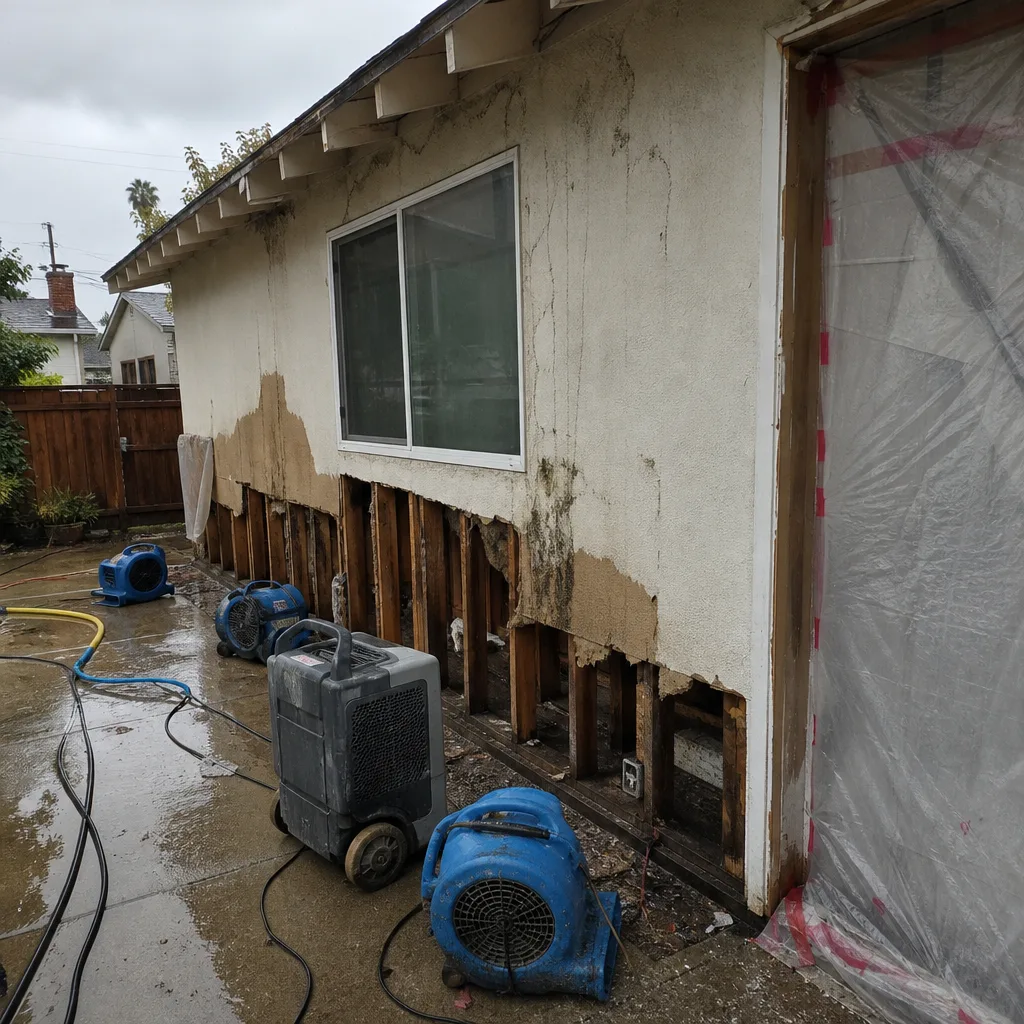 Before
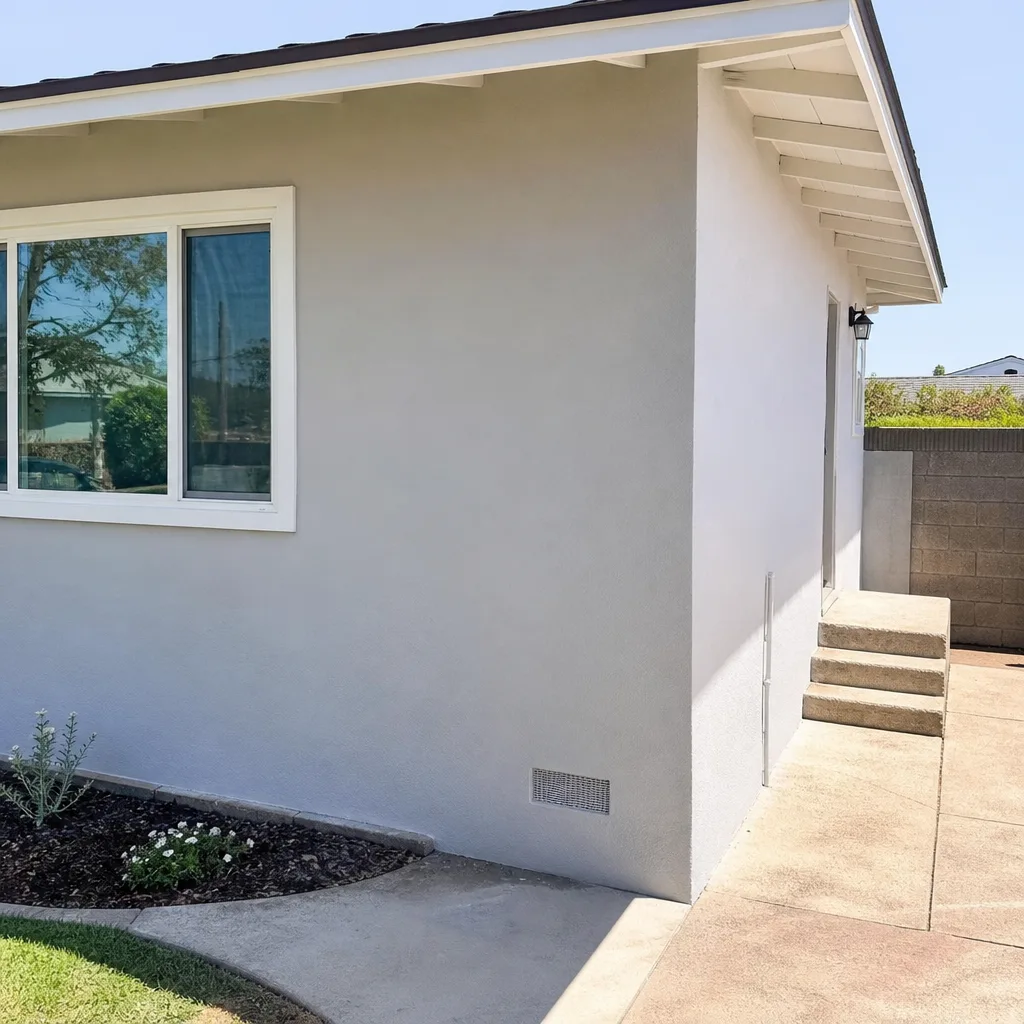 After
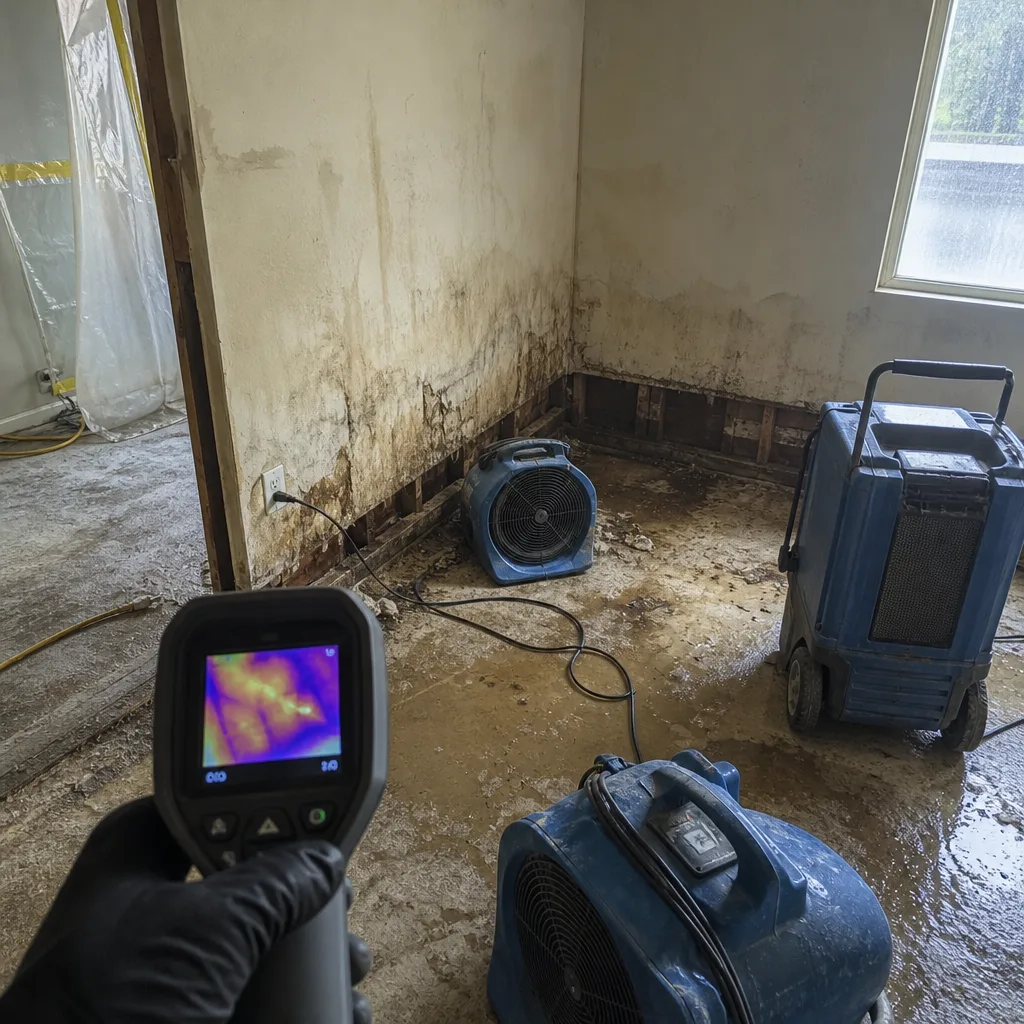 Before
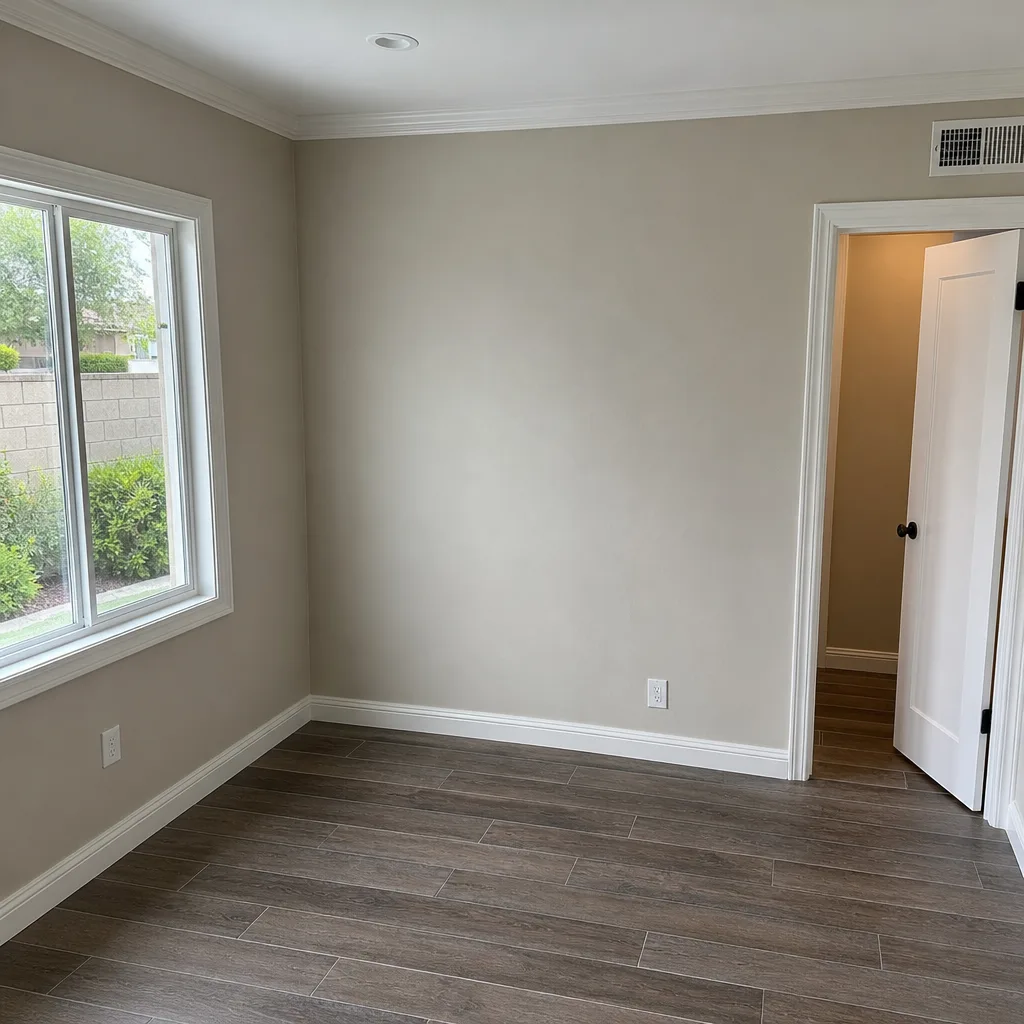 After
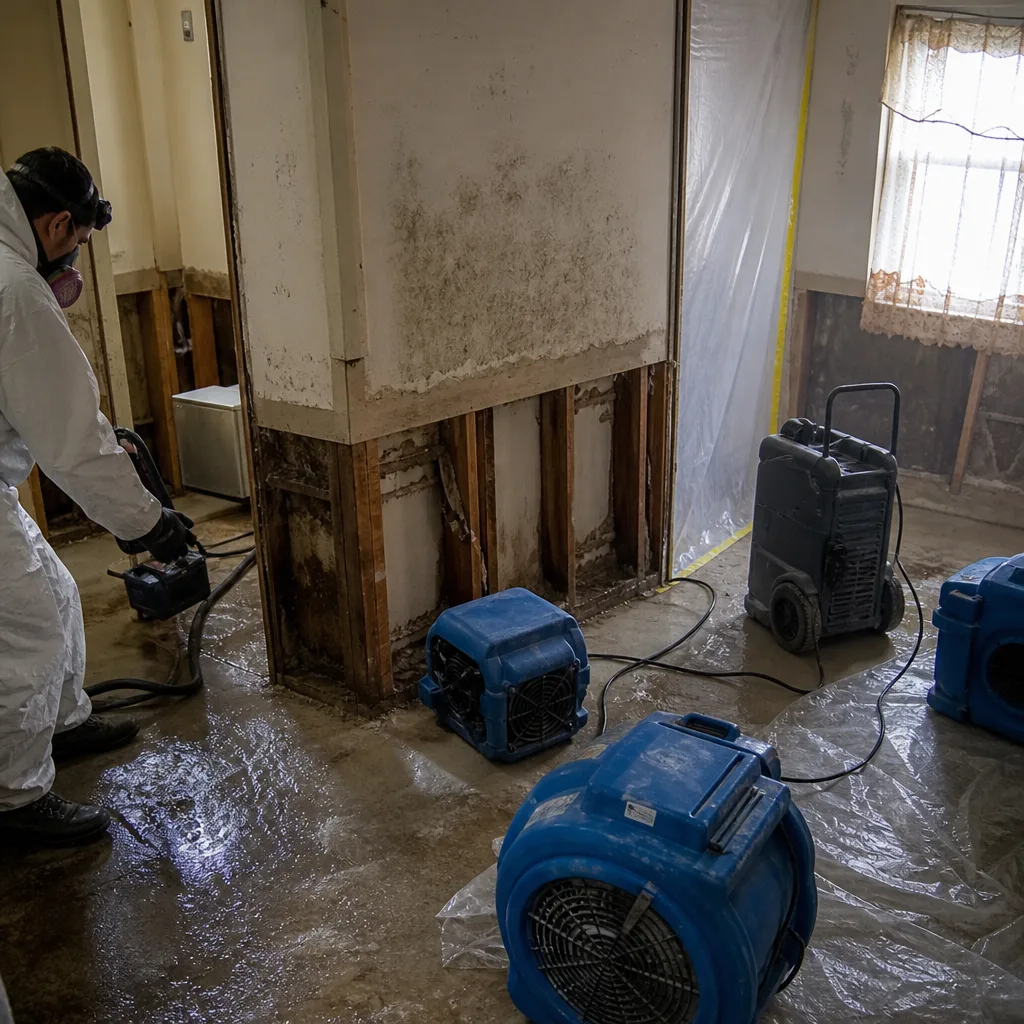 Before
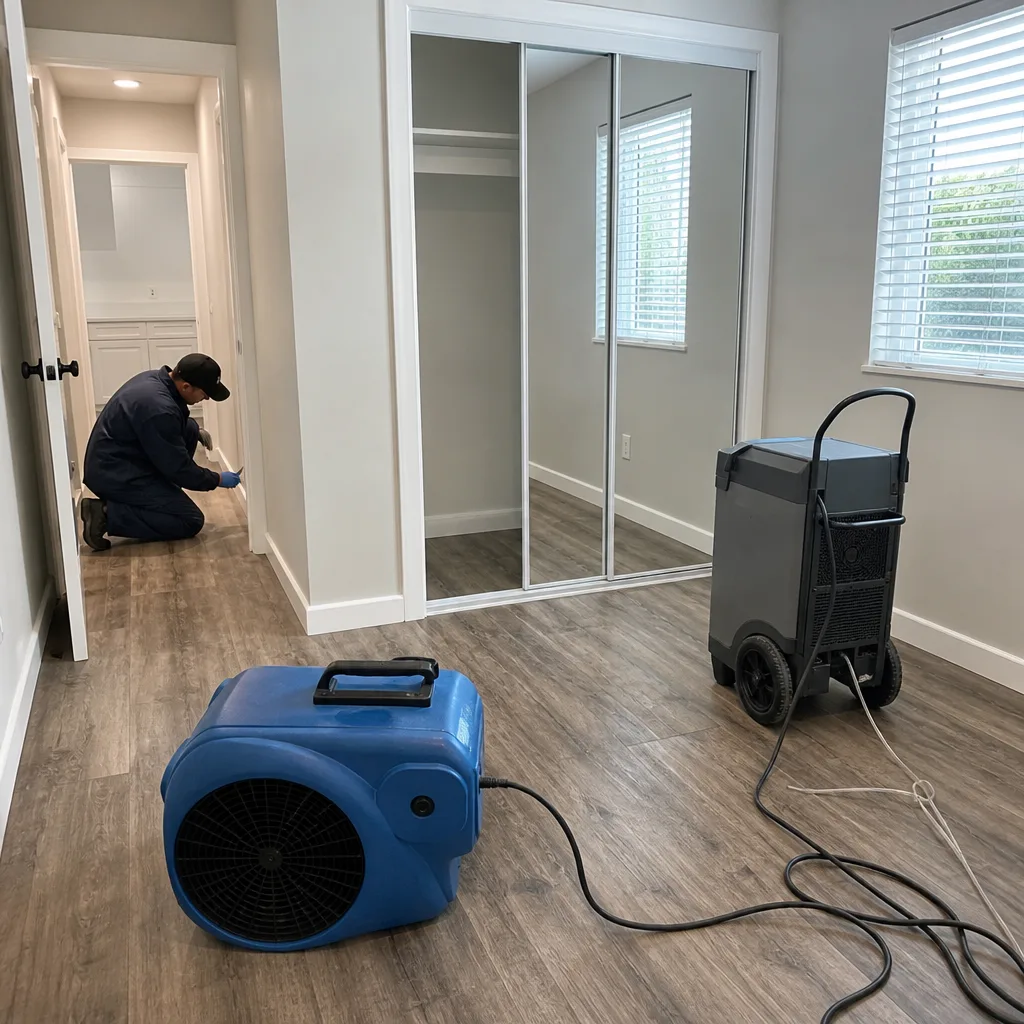 After
When to Call a Professional
Call a professional the moment any of these is true: the water is Category 2 or 3, the affected area exceeds 10 square feet, water reached or may have reached a wall or floor cavity, you see mold that extends beyond a small surface patch, anyone in the home has respiratory issues or a compromised immune system, or an insurance claim is being filed and you need documentation. You should also call if the water sat for more than 48 hours, regardless of the source. Stonecrest Water Damage offers free estimates in Buena Park, and we can tell you over the phone whether your situation is DIY-defensible or needs professional equipment. Call (833) 589-9161 before the degradation window closes, not after the smell starts.
Frequently Asked Questions
Water damage restoration in Buena Park typically ranges from $1,200 to $4,500 for a contained Category 1 or 2 event involving one or two rooms, depending on the extent of extraction, drying time, and any materials that need removal. Sewage or Category 3 jobs run higher. The exact quote depends on square footage, materials affected, and how quickly you call. Call (833) 589-9161 for a free estimate, and don’t wait; delay is the single biggest cost driver in restoration.
Only if the water is Category 1, the affected area is under 10 square feet, and nothing penetrated a wall or floor cavity. In almost every other scenario, rental equipment cannot remove water from building materials fast enough to prevent mold growth. In Buena Park’s warm climate, the mold-growth window is shorter than the national average, which makes underpowered equipment riskier here.
Most homeowners policies cover sudden and accidental water damage from sources like a burst supply line, an appliance failure, or a rainwater leak, but not gradual leaks, maintenance failures, or floodwater, which requires separate flood insurance. Restoration companies that work with insurers provide the moisture mapping, daily drying logs, and clearance reports adjusters require. Take photos and keep materials in place until the adjuster documents them.
Stonecrest Water Damage provides same-day emergency response in Buena Park for water damage events. In summer months, when the degradation window shrinks, same-day extraction and equipment placement matters more. Every hour of delay allows water to spread deeper into the structure. Call (833) 589-9161 as soon as you’ve stopped the source.
Drying addresses the moisture that could lead to mold growth, while mold remediation addresses mold that has already established. If water damage is dried to standard within 48 to 72 hours, mold typically never colonizes. If it sits longer, the job changes from drying to remediation, which involves containment, removal of colonized materials, treatment, and clearance testing. Remediation is significantly more expensive and invasive than drying.
If the leak was Category 1, dried within 48 hours, and never penetrated a cavity, a visual inspection is usually sufficient. Anything beyond that, including any Category 2 or 3 water, any cavity penetration, or any leak that sat undiscovered, warrants professional moisture assessment. We’ve found active mold growth in Buena Park walls months after homeowners believed a leak was fully handled.
Stop the source first, whether that’s a shutoff valve, the main water line, or a breaker. Then move contents off the wet surfaces, extract what you can safely reach with a shop vac, and call a restoration professional if the event exceeds the DIY conditions. Document everything with photos. Don’t turn on ceiling fixtures in a wet ceiling. Don’t use a vacuum on standing water unless it’s a rated wet/dry vac.
The Bottom Line
The DIY-versus-professional decision in damage restoration comes down to three verifiable conditions: Category 1 water, under 10 square feet, no cavity penetration. If all three hold and you act within 48 hours, a careful DIY approach with the right equipment can work. If any one fails, you’re no longer deciding between effort levels. You’re deciding whether to dry a structure to a measured standard or to dry its surface and hope. In Buena Park, where the climate hides moisture and the housing stock holds it, the odds favor the house. Stonecrest Water Damage runs commercial-grade equipment, follows IICRC S500/S520 standards, and provides the documentation your insurance adjuster and your future sale require. Call (833) 589-9161 for a free estimate before the window closes.
Written by the team at Stonecrest Water Damage, serving Buena Park since 2013.