
Water Damage Restoration Cost Guide: What Buena Park Homeowners Pay in 2026
Water damage restoration in Buena Park typically runs $2,400 to $14,500 for most single-room incidents in 2026, with whole-home mitigation rarely exceeding $35,000 unless structural rebuild is required. The spread comes down to scope: a drying-only job costs fundamentally less than drying plus demolition plus controlled-content processing. If you’d rather skip the math and get someone on site, call (833) 589-9161 for a free estimate.
Here’s the thing most cost guides won’t tell you: the lowest bid is almost never the cheapest outcome. We’ve walked into Buena Park homes where a $2,800 “quick fix” skipped cavity drying entirely, and the homeowner was back on the phone 90 days later with mold behind the baseboards. Insurance paid both claims, flagged the property, and the second job cost $9,000. Understanding what actually drives restoration pricing is how you avoid becoming that story.
This guide covers what Buena Park homeowners should expect to pay in 2026, why quotes vary so dramatically, and how to read a restoration invoice like an adjuster would.
Why Two Buena Park Quotes for the Same Leak Can Be $10,000 Apart
The reason isn’t price gouging. The reason is that two contractors are scoping entirely different jobs.
One contractor walks in, sees wet drywall, quotes replacement and paint. Another contractor walks in, takes moisture readings with penetrating and non-penetrating meters, discovers the wall cavity is saturated and the bottom plate of the wall is at 35% moisture content, and quotes structural drying with an Injectidry system plus containment and air scrubbing. Same leak. Different scope. The first quote is $3,200. The second is $11,800.
The first quote isn’t cheaper. It’s incomplete. When the wall cavity stays wet, you get mold, framing rot, and odor that requires far more invasive remediation down the line. In Buena Park, where summer humidity routinely sits above 70%, a wet cavity left alone doesn’t dry itself. It colonizes.
This is the single most important concept in restoration pricing: you’re not paying for labor hours. You’re paying for verifiable dryness. If a quote doesn’t include moisture documentation, it doesn’t matter what number is on it.
Key Takeaways So Far:
- Restoration quotes vary by scope accuracy, not greed
- A drying-only scope is not equivalent to a dry-and-document scope
- Buena Park humidity makes incomplete drying a mold risk within weeks, not months
- Always ask: does this quote include post-drying moisture readings?
The Five Cost Drivers That Actually Move the Number
When we price a water damage job in Buena Park, there are five variables that legitimately shift the total. Here they are, with realistic 2026 ranges.
1. Water Category (Clean, Gray, or Black)
Category 1 clean water from a supply line runs $2,400 to $5,500 for a typical single-room incident. Category 2 gray water (washing machine discharge, dishwasher overflow) adds antimicrobial treatment and controlled demolition, pushing the range to $3,800 to $8,000. Category 3 black water (sewage, outside floodwater) requires full containment, disposal of porous materials, and sometimes negative-air pressure setup, landing between $6,500 and $14,000 per affected room. The water’s source determines which materials can be saved and which must go.
2. Affected Square Footage
Restoration companies price by affected area, not total home size. A 120-square-foot bathroom leak costs less than 800 square feet of slab-floor flooding even in the same house. Expect roughly $18 to $32 per square foot for Category 1 water, depending on floor type and drying complexity. Tile over slab dries faster and cheaper than hardwood over raised foundation in Buena Park’s older neighborhoods, where 1950s and 1960s construction hides surprises under the subfloor.
3. Building Assembly Type
Slab-on-grade foundations respond slower to water intrusion under walls, requiring Injectidry systems or similar cavity-drying technology to avoid pulling baseboards and drilling into wall plates. Raised foundations in Buena Park’s central tract homes sometimes let water drain naturally below the subfloor, but that same drainage can wick moisture through insulation and support beams. This variable alone can swing a quote by $1,500 to $4,000.
4. Equipment Runtime Days
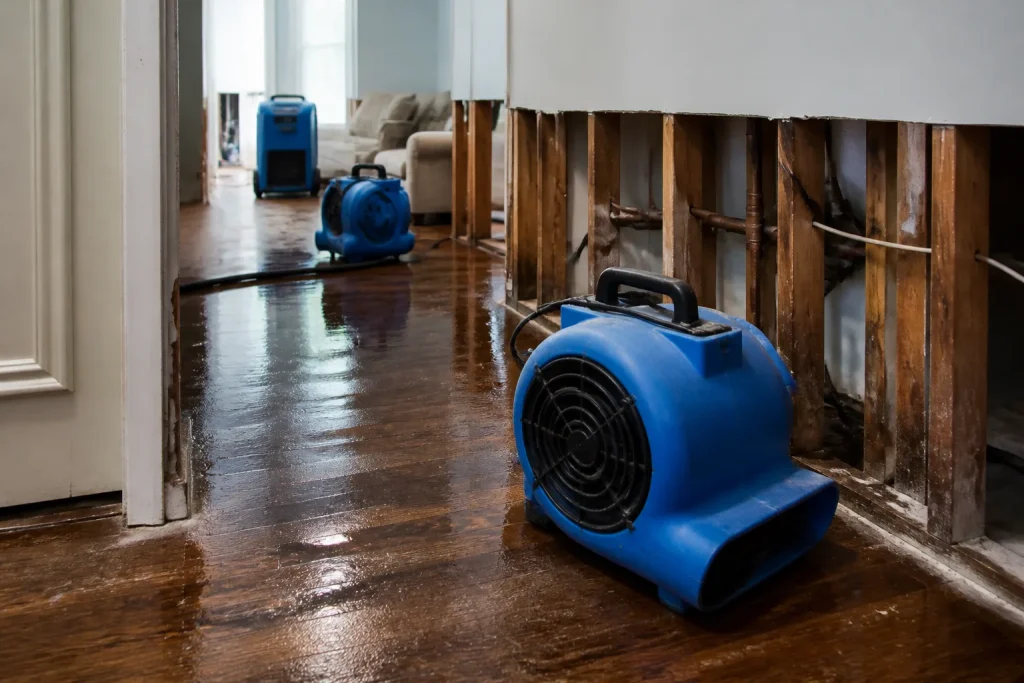
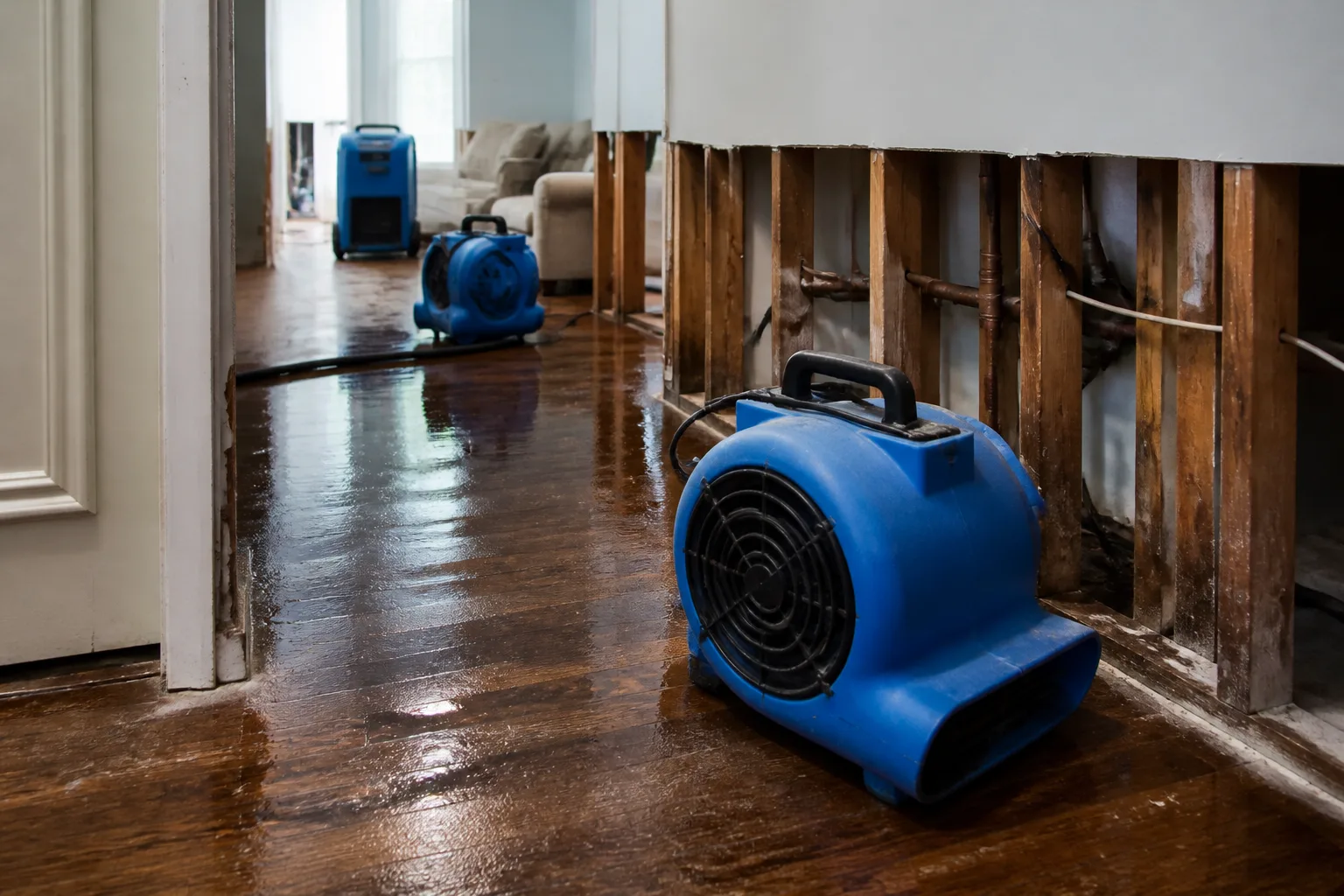
Commercial-grade drying in Buena Park typically runs 3 to 7 days. Each day of equipment operation includes monitoring visits, moisture readings at set intervals, and adjustments to placement and airflow. Rental-store fans might cost less per day, but they lack the LGR (low-grain refrigerant) dehumidification power of Dri-Eaz or Phoenix units that pull water vapor out of structural materials, not just the air. More equipment days means more documentation, and documentation is what insurance adjusters pay for.
5. Required Demolition
Drywall removal, baseboard pulling, carpet and pad disposal, and cabinet kicks all add cost. The difference matters: a drying-only scope might run $3,000, while the same job with 40 linear feet of drywall removal and disposal lands at $6,800. Demolition is where cheap bids often hide omissions. If a contractor says they’ll “dry it in place” without explaining how they’ll verify the cavity is dry without drilling or Injectidry, they’re not restoring. They’re hoping.
What Commercial-Grade Equipment Actually Costs, and Why It’s Worth It
You can rent a box fan and a small dehumidifier from a hardware store in Buena Park for about $45 a day. A full commercial drying setup with LGR dehumidifiers, high-velocity air movers, and moisture monitoring costs $400 to $900 per day in equipment charges on a restoration invoice. That looks like a ripoff until you understand what’s different.
Consumer dehumidifiers remove water from the air. Commercial LGR units from Dri-Eaz or Phoenix remove water vapor from structural materials by maintaining vapor pressure differentials that pull moisture out of wood, drywall, and concrete. Consumer fans circulate room air. High-velocity air movers from XPOWER create turbulent airflow across surfaces, accelerating evaporation at the material boundary layer. It’s the difference between pointing a fan at a wet sponge and putting it in a drying chamber.
We’ve pulled equipment off jobs in Buena Park after 4 days that a rental setup hadn’t touched in 3 weeks. The commercial route costs more per day and bills fewer days. It also produces a drying log with moisture readings every 24 hours, which is what your insurance company expects to see when they review the claim.
When a pro is worth it: If water touched multiple rooms, wicked under cabinets, or soaked into a wall cavity, call before you start moving furniture. The clock on mold starts the minute the water stops, and every day spent with rental equipment is a day the damage gets more expensive to fix correctly. For Buena Park homeowners, water damage restoration with documented drying records beats guessing every time.
How Insurance Adjusters Price Your Claim: ACV vs. RCV
This is where Buena Park homeowners lose real money without realizing it.
Your insurance policy pays one of two ways: Actual Cash Value (ACV) or Replacement Cost Value (RCV). ACV is the depreciated value of the damaged materials. RCV is what it actually costs to replace or restore them to pre-loss condition. With RCV coverage, your insurer typically releases the ACV amount first, then pays the difference once restoration is complete and documented.
Here’s the trap: if you accept a restoration bid that doesn’t include line-item documentation, the adjuster has no basis to approve the supplemental payment. You’re stuck with the depreciated amount. A legitimate restoration invoice includes equipment days, moisture readings at start and completion, technician hours broken out, disposal weights, and materials. A vague flat-rate quote of “$6,000 for water damage” delivers none of that.
We’ve worked with Buena Park homeowners whose initial adjuster estimate came in at $4,200 for a job that ultimately required $11,300 in restoration. The difference was recovered because the invoicing matched the IICRC S500 standard: each equipment day logged, each moisture reading timestamped, each demolition item listed separately. Insurance companies don’t argue with documentation. They argue with ambiguity.
For mold or fire involvement on the same claim, mold remediation and fire damage restoration follow the same documentation rules. One certified team handling all three means the paper trail stays consistent from mitigation through rebuild.
Structural Drying vs. Mold Remediation: How One Job Becomes Two Claims
The difference between a $4,000 water job and a $13,000 water-plus-mold job is usually 6 to 10 weeks.
Water enters a wall cavity behind the baseboard. If the cavity isn’t dried with injectable drying systems or targeted demolition, the moisture stays trapped. In Buena Park’s climate, mold colonization starts within 48 to 72 hours on saturated drywall paper and wooden framing. By week 6, you can smell it. By week 10, you’re looking at containment, HEPA air scrubbing, removal of affected drywall, treatment of framing, and post-remediation verification. That’s a separate claim, a separate deductible, and a separate headache.
We’ve been called to Buena Park homes where a previous contractor “dried” a kitchen leak with fans for 3 days and walked away. The wall felt dry to the touch. Four months later, black staining bloomed behind the cabinets. The homeowner’s insurance company paid both claims but raised the premium and flagged the property for future underwriting review. The cheapest bid ended up being the most expensive option.
This is why we run moisture meters, not just our hands, during every drying job. A wall can feel dry at the surface and still hold 28% moisture content 2 inches deep. That’s not restoration. That’s postponement.
What a Legitimate Restoration Invoice Includes
One of the best defenses against a bad bid is knowing what a real invoice looks like. If you’re evaluating restoration quotes in Buena Park, compare them against this checklist.
- Water source category documented (Category 1, 2, or 3, with justification)
- Affected square footage measured (not eyeballed)
- Equipment list with days in use (e.g., “2 Dri-Eaz LGR 2800i units, 6 days”)
- Moisture readings at start, daily, and completion (target: wood below 14%, drywall below 12%)
- Demolition items listed separately (baseboard LF removed, drywall SF removed, carpet SF disposed)
- Technician hours broken out by day
- Disposal and debris removal costs itemized
- Post-drying verification report with moisture mapping
A flat-rate quote that says “water damage cleanup: $5,800” hides all of this. A line-item invoice shows you exactly what you’re paying for and gives your adjuster what they need to approve the full claim. Around Buena Park, most homeowners save more by scrutinizing scope accuracy than by chasing lower prices.
If you’re already dealing with water in the home and need a professional eye on the damage, Stonecrest Water Damage home services include free on-site assessments with moisture mapping.
What happens when you call
- 1
A real person answersNo phone trees — you reach a local pro.
- 2
You get an upfront price rangeHonest numbers before anyone is dispatched.
- 3
A background-checked tech heads outLicensed & insured, dispatched right away.
- 4
You approve before work beginsNothing starts until you say go.
The Bottom Line
Water damage restoration in Buena Park costs $2,400 to $14,500 for most single-room incidents in 2026, with the final number driven by water category, square footage, construction type, equipment runtime, and demolition scope. The cheapest quote is almost never the cheapest outcome. A documented drying job with commercial equipment and verifiable moisture readings costs more upfront and far less overall.
When you compare bids, compare scope accuracy first. Ask for moisture readings. Ask which equipment they’re running. Ask if the invoice will be line-itemed for your adjuster. A contractor who answers those questions confidently is restoring your home. One who deflects is patching it.
If you’re in Buena Park and need help, Stonecrest Water Damage offers free estimates, documented drying to IICRC standards, and direct insurance coordination. Call (833) 589-9161 and we’ll walk you through what you’re looking at.
Frequently Asked Questions
Most single-room water damage restoration jobs in Buena Park run between $2,400 and $14,500 in 2026. The final cost depends on water category, affected square footage, your home’s foundation type, how many days of equipment drying are needed, and how much demolition is required. Large multi-room incidents can reach $35,000. For an exact quote on your situation, call (833) 589-9161.
Homeowners insurance typically covers water damage from sudden, accidental events like a burst pipe or appliance failure, but not from gradual leaks or poor maintenance. Coverage depends on your policy, and most pay ACV first, then RCV once documented restoration is complete. Line-item invoices with moisture readings help ensure your adjuster approves the full claim. If you need help coordinating with your insurance company, call Stonecrest Water Damage at (833) 589-9161.
Most structural drying jobs in Buena Park take 3 to 7 days with commercial LGR dehumidifiers and high-velocity air movers. Mold remediation can add 3 to 5 days on top of that. The biggest factor is whether drying can be done in place or requires demolition. Homeowners who call within 24 hours generally see shorter equipment runtime and lower total costs.
You can dry surface water, but you can’t verify that wall cavities and structural materials are actually dry without moisture meters and commercial-grade equipment. Rental fans and consumer dehumidifiers don’t pull water from inside drywall or wood at the rate required to prevent mold. In Buena Park’s humid climate, incomplete drying invites mold within weeks. Call (833) 589-9161 for an assessment before the damage compounds.
Written by the team at Stonecrest Water Damage, serving Buena Park since 2013.
Need Damage Restoration Help?
Call Stonecrest Water Damage — licensed & insured, here with fast after-hours help in Brea.
(833) 589-9161