How to Choose the Right Damage Restoration Company in Buena Park
Choosing a damage restoration company in Buena Park comes down to two things: equipment and documentation. A qualified contractor shows up with calibrated drying systems, produces a daily moisture log, and can hand you a Certificate of Completion that meets IICRC S500 standards. A contractor who can’t do those three things is guessing, no matter how friendly the crew is. If you’d rather skip the vetting process and talk to someone directly, call us at (833) 589-9161.
Here’s the thing most homeowners in Buena Park don’t realize until it’s too late: a restoration company with 200 Google reviews and no psychrometric documentation capability will leave your walls wetter than the IICRC standard allows. And you’ll have no paper trail to prove it when mold shows up in a wall cavity three months later. Reviews measure courtesy. They don’t measure moisture content.
Key Takeaways
- Ask for three documents: technician certifications, equipment calibration records, and a sample drying log from a completed job.
- Commercial LGR dehumidifiers and axial air movers are non-negotiable on any water loss over a few square feet.
- “We work with your insurance” means nothing unless the company produces a documented scope that an adjuster can verify line by line.
- Compare bids by scope, not total price. Two quotes can differ by thousands because one skips steps the IICRC S500 requires.
- Independent moisture verification protects you when a general contractor recommends their own restoration crew.
The Three Documents Every Legitimate Restoration Contractor Must Produce
Before you sign anything with a restoration company in Buena Park, ask for three things. Most contractors can’t produce all three, and that tells you everything.
First, ask for individual technician certifications. Not the company’s membership certificate. The actual techs who will walk into your home need their own IICRC certifications in water damage restoration, applied structural drying, or mold remediation. We’ve seen companies flash a wall full of plaques and then send out uncertified labor. If the tech’s name isn’t on the cert, it doesn’t count.
Second, ask for equipment calibration records. Moisture meters and thermal imaging cameras drift out of calibration over time. A meter that’s off by 10% can declare a wall dry when it’s still holding enough moisture to feed mold. Legitimate companies in Buena Park calibrate their instruments on a schedule and can show you the log. We run Phoenix and XPOWER units alongside calibrated Delmhorst meters because a dry standard only matters if the tool measuring it is accurate.
Third, ask for a sample drying log from a completed job. A real drying log shows daily moisture readings from affected materials, ambient temperature, relative humidity, and grains per pound readings. It tracks the drying curve over days, not hours. A contractor who stares blankly at this request has never documented a job in their career. Walk away.
Equipment Audit: What Commercial Drying Gear Actually Looks Like
When a restoration crew pulls up to a house in Buena Park, the equipment on the truck tells you more than their sales pitch ever will. Here’s what to look for during the first hour on site.
LGR dehumidifiers. Low-grain refrigerant units are the industry standard for structural drying. They pull moisture out of the air down to much lower humidity levels than the rental-store units you can buy at a big-box store. On a typical water loss in a Buena Park home, we’ll place one LGR per affected room plus one staging unit. If the contractor shows up with a single household dehumidifier from a local rental shop, they’re not doing restoration. They’re doing air circulation and hoping for the best.
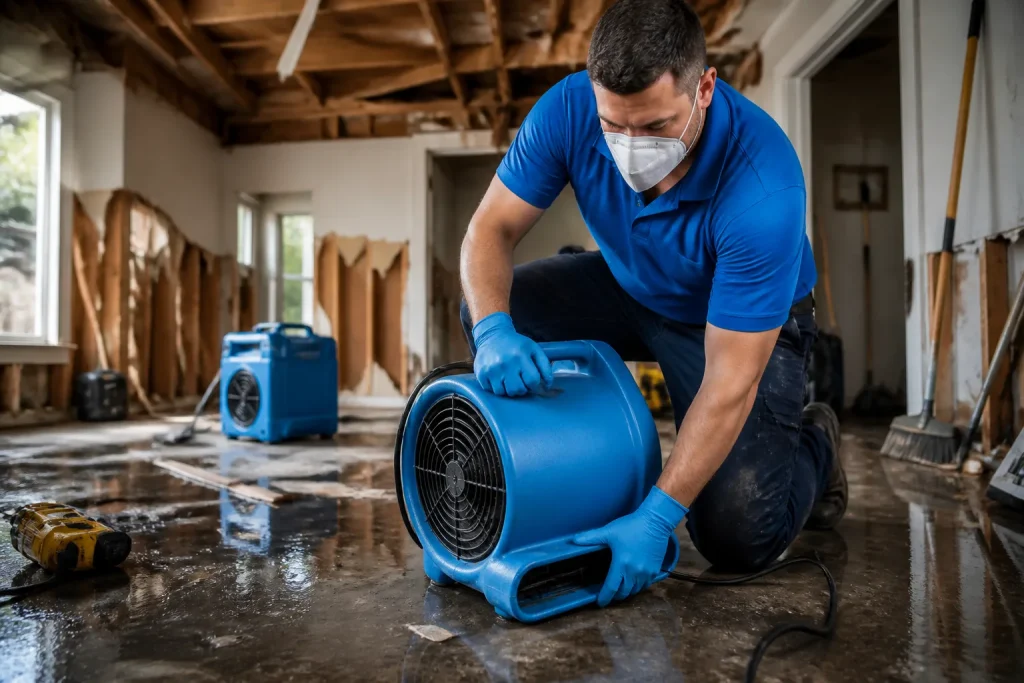
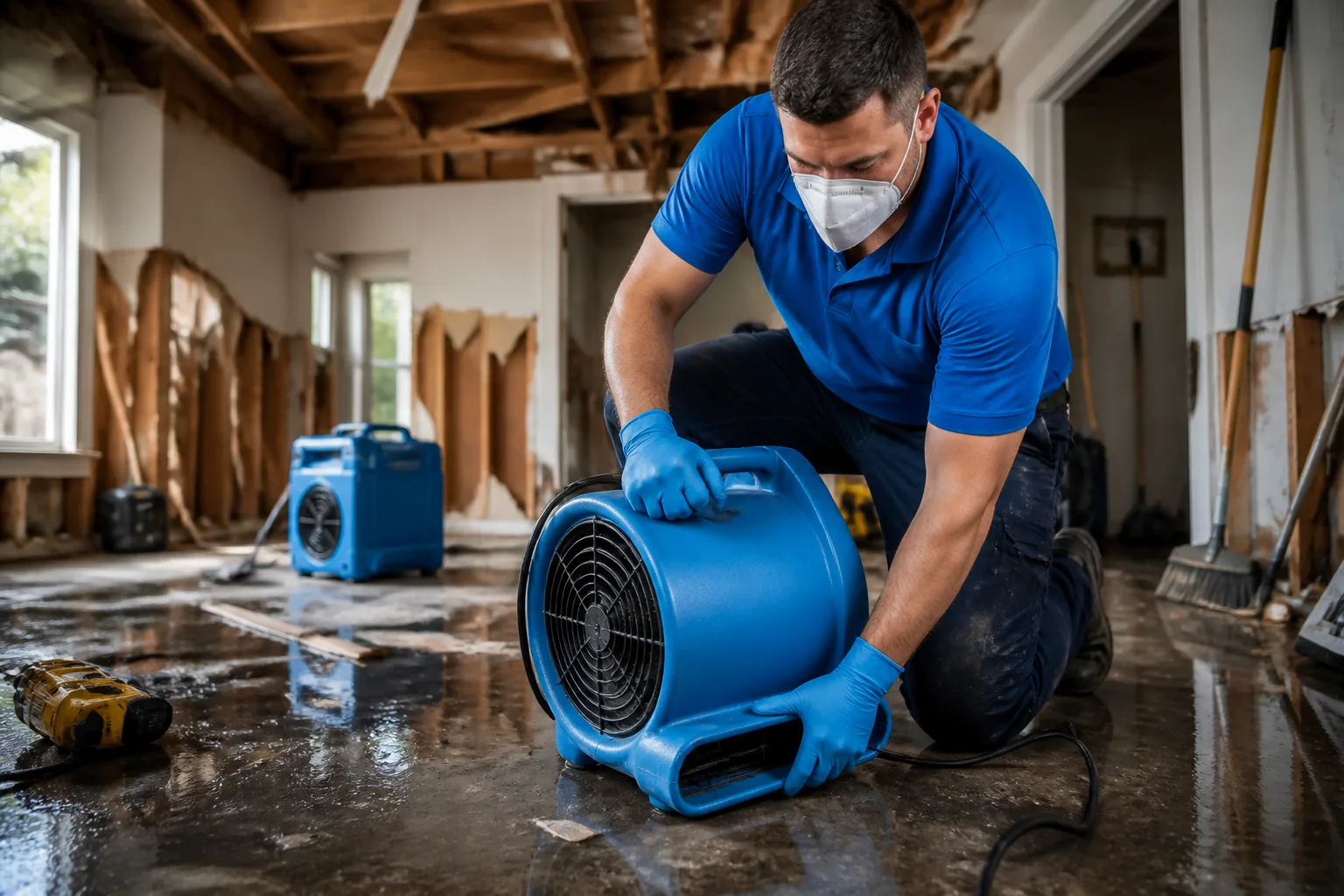
Axial air movers. These are the high-velocity fans that drive evaporation off wet drywall, carpet, and subfloor. Proper placement matters, and so does the count. A 200-square-foot water loss typically needs six to ten air movers positioned to create a vortex of airflow across wet surfaces. Less than that means longer drying times and a higher chance of secondary damage.
Thermal imaging cameras. Moisture hides inside wall cavities, under baseboards, and behind cabinets. A thermal camera reveals temperature differentials caused by evaporative cooling, showing exactly where water has traveled. Every certified crew working in Buena Park should carry one. We use them on every water loss because guessing where the water went means missing half the problem.
Injectidry systems. This is the equipment most general contractors have never heard of. Injectidry forces dry air directly into wall cavities and under hardwood floors, drying the structure from the inside without ripping out drywall or flooring. It preserves more of the original structure, reduces demolition waste, and gets families back into their homes faster. The absence of this kind of tool on a job doesn’t automatically disqualify a contractor, but its presence tells you they’re serious about efficient structural drying. We run Injectidry panels on a significant portion of our Buena Park jobs because demolition is expensive and often unnecessary.
Why “We Work With Your Insurance” Is a Neutral Statement
Every restoration contractor in Buena Park says they work with insurance. It’s the lowest bar in the industry. The real question is how they work with insurance.
Legitimate companies work with adjusters from a position of documented scope. That means every affected area is identified, measured, and photographed. Moisture readings are recorded before, during, and after drying. Line items on the estimate reference specific IICRC S500 or S520 standards. The adjuster can verify the work was necessary because the documentation proves it.
Contractors who suppress line items to keep a claim under a threshold, who waive deductibles, or who “handle everything” without showing you the scope are not doing you favors. They’re cutting corners to keep the adjuster happy, and you’re left with whatever got skipped. Sometimes that’s a partially dried wall cavity. Sometimes it’s a mold problem that surfaces after the claim is closed and the contractor is long gone.
In our experience working with Buena Park homeowners, the insurers we deal with respect documented scope. They see a drying log with daily readings and a photo record of every affected room, and the claim moves faster. The homeowners who get pushed around are the ones whose contractor submitted a one-page estimate with vague line items like “dry structure” and “clean affected areas.” That tells the adjuster nothing, so the adjuster assumes the worst and cuts accordingly.
How to Compare Two Bids for the Same Job
You’ve got two restoration bids from two Buena Park companies. One is $4,200. One is $6,800. Your instinct says take the cheaper one. That instinct is wrong.
The correct way to compare restoration bids is line by line against the IICRC S500 standard for water damage restoration. Here’s the checklist we recommend to anyone in Buena Park evaluating quotes:
- Does the bid include initial moisture mapping? If a bid doesn’t list thermal imaging or moisture meter readings across all affected rooms, it assumes the water stayed where you can see it. It almost never did.
- Does it include daily monitoring? IICRC S500 requires monitoring at least once every 24 hours during active drying. A bid without monitoring means no one is checking whether the drying is working. You find out the job failed when the wood starts warping.
- Does it include containment? For mold remediation, containment barriers with negative air pressure are standard. A cheap bid that skips containment spreads spores through the rest of the house.
- Does it include antimicrobial application? After water extraction, affected surfaces need antimicrobial treatment to prevent mold growth. Skipping this step saves a few hundred dollars and invites a bigger problem.
- Does it include a final moisture verification? A proper job ends with moisture readings showing all affected materials at or below the dry standard for your climate zone in Buena Park. No final readings, no proof of completion.
We pulled equipment out of a garage over near the Buena Park Mall last month where the homeowner had hired a cut-rate crew the year before. The total was low, but the final invoice didn’t include final moisture readings. Eight months later, the baseboards were swelling and the drywall behind the baseboards was blooming with mold. The cheap bid cost her triple by the time we finished.
The Conflict-of-Interest Risk With General Contractors
Here’s a scenario we see regularly in Buena Park: a pipe bursts, the homeowner calls their general contractor, and the GC says they can handle the water damage and the rebuild. One crew, one invoice, less hassle. Sounds efficient.
The problem is the incentive structure. A general contractor makes their margin on rebuilding. Demolition, drying, and remediation are costs that eat into the rebuild budget. The faster the GC declares the structure dry, the sooner they start the profitable work. That’s not a critique of general contractors. It’s a structural reality of how their business works.
Independent moisture verification protects you here. A restoration company that doesn’t do the rebuild has no incentive to rush drying. Our job is to get the moisture readings down to the IICRC dry standard and document it. If the structure isn’t dry, we keep drying it. There’s no next phase we’re trying to reach. The drying is the job.
When you’re comparing restoration options in Buena Park, ask whether the company doing the drying is also doing the rebuild. If they are, ask who verifies the final moisture readings. If the answer is “we do,” you’re trusting the same people who profit from moving fast to tell you honestly when the job is done. That’s not a bet you should take on a structure you sleep in.
Why Equipment and Certification Matter More Than Reviews
Let’s be direct: a five-star review means a crew was polite, showed up on time, and left the place looking clean. It says nothing about whether the wall cavities are dry or whether the subfloor will buckle in six months. Mold doesn’t write Google reviews.
The restoration industry in Buena Park has a certification problem. Any handyman can buy a wet vac, print some business cards, and call themselves a water damage specialist. The IICRC, RIA, and IFA exist precisely because unqualified contractors were doing billions in preventable secondary damage. Companies that carry IICRC certifications, maintain RIA membership, and operate under IFA standards have committed to documented, testable protocols. They can show you the standard they’re working to. A guy with a truck and a wet vac cannot.
Equipment tells the same story. Dri-Eaz, Phoenix, XPOWER, and B-Air build commercial drying systems for professional restoration. These are not rental-store machines. They’re engineered for continuous operation over days, not hours, with the airflow and moisture removal capacity to dry structures properly. A contractor who invests in commercial-grade equipment is making a statement about how they work. A contractor with two box fans from a discount store is making a different kind of statement.
If you want to go deeper on what proper water damage restoration in the area looks like, see our breakdown on Water Damage Restoration in Brea, which covers the process step by step.
When to Call a Pro
Water damage, mold, and fire aftermath are not DIY projects. Water migrates into wall cavities and under flooring where you can’t see it. Mold spreads through the air and behind surfaces. Fire damage leaves soot and smoke residue embedded in porous materials. A homeowner with a shop vac might remove visible water. They will not dry a wall cavity to IICRC standards, and they will not document the process for an insurance claim.
If you’re dealing with any of these situations in Buena Park, call a certified restoration company before the damage spreads. The cost of professional assessment is a fraction of the cost of secondary damage.
Related services in Buena Park: Mold Remediation in Brea covers what happens when moisture problems are ignored, and Fire Damage Restoration in Brea walks through the cleanup and restoration process after a fire.
The Bottom Line
Choosing a restoration company in Buena Park is an equipment and documentation audit. Ask for technician certifications, calibration records, and a sample drying log. Look for commercial LGR dehumidifiers, axial air movers, thermal imaging, and Injectidry capability on the truck. Compare bids by scope against IICRC S500, never by total price alone. And be wary of any arrangement where the company doing the drying is also the company profiting from the rebuild.
If you’re in Buena Park and need help with water, mold, or fire damage, Stonecrest Water Damage home offers free estimates and honest assessments. Call (833) 589-9161 and we’ll walk through your situation, tell you what we’d recommend even if you don’t hire us, and give you a documented scope so you can compare it against any other bid with confidence.
Frequently Asked Questions
Ask for individual technician certifications, not just the company’s credentials. Each tech who will work in your home should hold current IICRC certifications in the relevant category (water, mold, or fire). Verify the cert number and the tech’s name match. In Buena Park, any certified company should be able to produce this documentation in minutes.
A proper drying log includes daily moisture readings from affected materials, ambient temperature, relative humidity, grains per pound, and equipment placement notes. Readings should show a clear downward trend over consecutive days. If a contractor can’t produce a sample drying log from a previous job, they likely don’t document their work. Call (833) 589-9161 if you want to know what a documented job looks like.
Rarely. Cheap bids usually omit required steps like daily monitoring, antimicrobial application, containment, or final moisture verification. That’s how a $3,000 water job becomes a $15,000 mold remediation. Compare bids line by line against IICRC S500 requirements, not by total price.
Most homeowner policies cover sudden and accidental water damage and fire damage. Mold coverage varies by policy and cause. The key is documentation. A restoration company that produces photo records, daily moisture logs, and a detailed scope gives your adjuster what they need to approve the claim promptly. We coordinate directly with adjusters on behalf of our Buena Park clients.
Written by the team at Stonecrest Water Damage, serving Buena Park since 2013.
Need Damage Restoration Help?
Call Stonecrest Water Damage — licensed & insured, here with fast after-hours help in Brea.
(833) 589-9161