

Last updated October 31, 2026
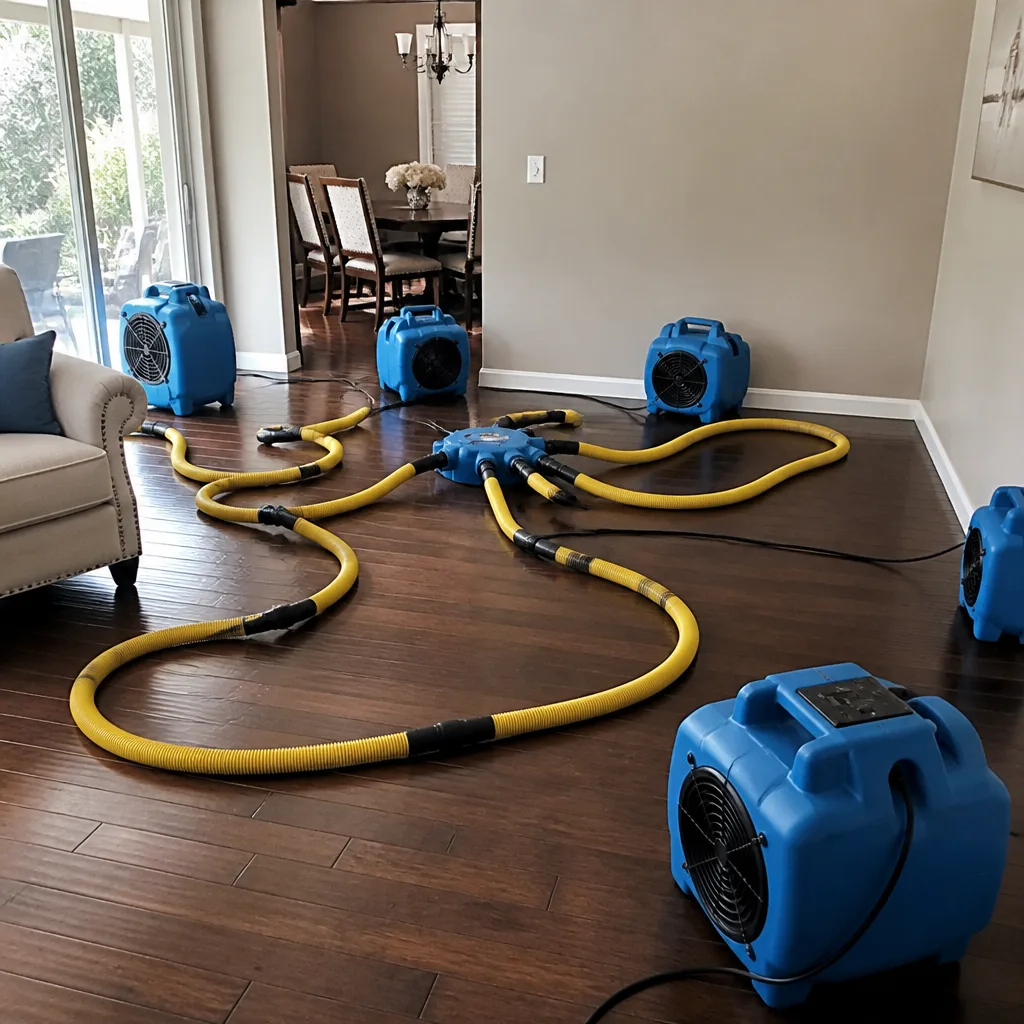 Water damage drying
 Fire & smoke cleanup
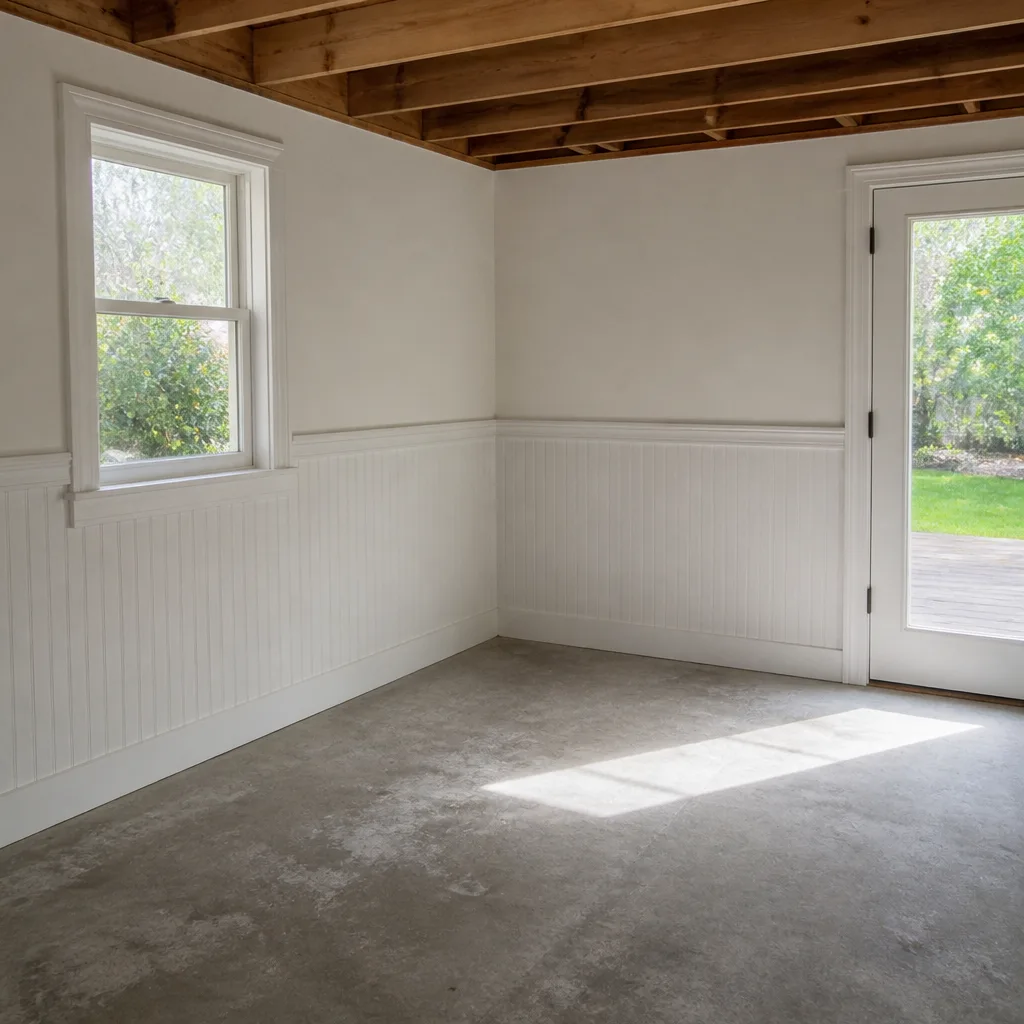 Mold remediation
 Storm response
 Sewage cleanup
 Reconstruction
Free visual inspection and a written scope of work before any mitigation begins - photos, moisture readings, and drying logs go in your claim file
The scope we write is the scope we bill. Anything new gets shown to you, in writing, before we touch it.
Get your free estimateDamage Restoration Emergency Preparedness Guide for Buena Park Homes
The first 20 minutes after a major plumbing failure determines whether a Buena Park homeowner is dealing with a $4,000 water damage claim or a $40,000 structural loss. That window is almost entirely determined by one thing: how fast the water supply gets shut off. Most homeowners in Buena Park spend those first 20 minutes searching for the shutoff valve, calling a neighbor, or watching water spread into drywall and flooring because nobody ever showed them where to turn. This guide fixes that. You’ll learn how to map every shutoff in your home now, document your property before anything happens, make the right triage decisions in the first 10 minutes, and know exactly what to tell the restoration company when you call. For DIY vs Professional Damage Restoration: The Buena Park Homeowner’s Decision Guide, see our comparison. None of this requires special tools or technical skill. It requires about 90 minutes of your time now, before the pipe bursts.
Restoration work we handle
Quick Answer
Water damage emergency preparedness for a Buena Park home means knowing where every water shutoff is located, having a pre-documented photographic baseline of your property for insurance purposes, and following a simple first-10-minutes triage sequence: shut off the water, cut power to affected areas when standing water contacts outlets or appliances, move contents out of the water path, and call a certified restoration team immediately. The goal is eliminating the confusion window where a manageable leak becomes a structural loss.
Table of Contents
- Mapping Every Shutoff in Your Buena Park Home
- Pre-Event Documentation: Your Insurance Baseline
- The First-10-Minutes Triage Decision Tree
- Water and Electricity: When to Kill the Power
- What to Tell the Restoration Company When You Call
- Why Buena Park Homes Face Specific Water Damage Risks
- What Actually Belongs in a Water Damage Emergency Kit
- Common Mistakes to Avoid
- When to Call a Professional
- Frequently Asked Questions
- The Bottom Line
Mapping Every Shutoff in Your Buena Park Home
Most Buena Park homes have between three and seven water shutoff points, and the average homeowner can find exactly one of them. The main shutoff at the street is the one everyone knows about, but when a supply line bursts under a bathroom sink, running to the street costs valuable minutes. A fixture-level shutoff does the same job in three seconds.
Here’s the step-by-step protocol we recommend for every home:
- Locate the main house shutoff. In most Buena Park homes built before 1990, this is a gate valve or ball valve where the water line enters the house, typically near the front wall facing the street, in a crawl space, or in the garage. In newer construction, it’s usually in the garage near the water heater or in a utility closet. Turn it clockwise to close. Test it quarterly: close it fully, then open it again to prevent mineral buildup from seizing the valve.
- Find the street-level shutoff. This is your backup if the house valve fails. In Buena Park, it’s typically located in a concrete or plastic meter box at the property line, near the curb. You’ll need a meter key or a crescent wrench to turn the valve. Keep a meter key in the garage; they cost about $15 at any hardware store in Buena Park.
- Document every fixture-level shutoff. Each toilet, sink, dishwasher, washing machine, and water heater has an individual shutoff. These are small oval handles or straight levers on the supply lines behind or beneath the fixture. For toilets, it’s on the wall or floor behind the bowl. For sinks, it’s inside the cabinet, often two valves (hot and cold). For washing machines, it’s either a single lever or two-valve pair where the supply hoses meet the wall box.
- Label everything. Use a label maker or permanent marker and masking tape. Write “Main Shutoff,” “Washer Hot,” “Kitchen Cold,” etc. In an emergency, adrenaline makes small print unreadable. Big, obvious labels save minutes.
- Take photos and put them in one place. Photograph each shutoff location with enough context to find it again: wide shot, then close-up. Store all photos in a folder on your phone named “Shutoffs” or in a home emergency binder. Show every capable adult in the household where that folder lives and what the photos show.
- Test every valve once. Close and reopen each fixture shutoff. This confirms it works and loosens any buildup. If a valve is frozen, mineralized, or leaking when operated, replace it now, not after a flood starts.
In our experience with Buena Park homes, the washing machine supply lines are the most common point of catastrophic failure, and they’re also one of the valves homeowners are least likely to have located and tested. Steel-braided supply lines last roughly 5 to 8 years. If yours are older than that, replace them now. It’s a $20 part that prevents thousands in damage.
Pre-Event Documentation: Your Insurance Baseline
Insurance claims get complicated when the adjuster can’t verify what existed before the damage. If you can’t prove you had solid oak flooring under that carpet, you’ll be compensated for builder-grade carpet. If you can’t show that custom cabinets were installed two years ago, the settlement reflects age and wear assumptions that almost always favor the insurer. The solution is a pre-event documentation package that costs you nothing but one evening and a phone camera.
Do this now, while everything is dry and intact:
- Photograph every room from two angles. Wide shots that show the full room, then closer shots of floors, walls, ceilings, trim, and built-ins. Include the date stamp or use a time-stamped camera app.
- Film a slow walkthrough of the entire home. Narrate as you go: “Entryway has travertine tile installed 2019, solid oak door, chair rail molding.” A two-minute video covers what fifty photos miss.
- Photograph mechanical systems. Water heater, HVAC unit, electrical panel, sump pump if you have one. These are high-value replacement items that get damaged or destroyed when water rushes through a garage or mechanical closet.
- Photograph contents in closets, cabinets, and storage areas. Adjusters know homeowners inflate contents lists. Photographs of what was actually in the linen closet or the garage shelving are hard to dispute.
- Log purchase records and serial numbers. Create a simple spreadsheet or use a home inventory app. For big-ticket appliances, photograph the label showing make, model, and serial number.
- Store everything off-site. If the only copy of your documentation is on a phone that gets soaked or a hard drive in a flooded office, it’s useless. Use cloud storage: Google Drive, iCloud, Dropbox. Share the folder with a family member outside Buena Park or keep a physical copy in a fireproof safe at a relative’s house.
This documentation works for water, mold, and fire damage. The same pre-loss baseline that proves your hardwood floors existed before the pipe burst also proves they existed before the kitchen fire. Stonecrest’s Water Damage Restoration in Brea team works with homeowners across the Buena Park area who have claims moving faster because their pre-loss documentation removes the adjuster’s guesswork.
One additional step specific to Buena Park: photograph any exterior drainage features. French drains, retaining walls, downspout extensions, and grading contours affect whether heavy winter rain infiltrates your foundation or slab. A record of the drainage in good condition helps establish that water intrusion was not a pre-existing condition, which is the most common reason water damage claims are reduced or denied.
The First-10-Minutes Triage Decision Tree
The moment you discover active water intrusion, your brain wants to do three things: panic, call someone who can’t help, and start moving wet belongings. All three waste time. Here’s the decision sequence we train our clients on, in order:
Minute 1-2: Shut off the water.
- If water is actively flowing from a fixture, toilet, sink, washer, or water heater, close the nearest fixture shutoff.
- If you can’t find a fixture shutoff or the leak is in a wall, ceiling, or floor, go to the main house shutoff and close it.
- If the main house shutoff won’t turn or you can’t find it, go to the street-level shutoff. This is your failsafe.
Minute 2-3: Kill the power, if necessary.
- If standing water is in contact with any electrical outlet, power strip, extension cord, appliance, or if water is coming through a ceiling below a light fixture or fan, cut power at the breaker panel immediately. Flip the breaker for the affected area. If you’re unsure which breaker controls that zone, shut off the main breaker.
- If the water is a small, contained puddle with no electrical contact, you can leave the power on and move to the next step.
Minute 3-5: Move contents out of the water path.
- Move furniture, rugs, electronics, books, and anything with sentimental or monetary value to a dry area. Be strategic: move the most valuable items first, then the most water-sensitive items. Leather sofas and electronics absorb water fast. Solid wood tables resist it longer.
- If you can safely lift wet area rugs and move them outside or to a garage, do so. A wet rug left on a hardwood floor or carpet will double the drying time and increase the chance of permanent staining and mold growth.
Minute 5-7: Contain the spread.
- Use towels, blankets, or even couch cushions to create a temporary dam or soak up standing water. Focus first on areas where water is approaching doorways, floor vents, or floor transitions between different materials. Water traveling under baseboards and into wall cavities is where hidden damage begins.
- If the leak was above a ceiling, place buckets or pots under the drip and consider punching a small drain hole at the lowest point of the sagging drywall to release the water weight and prevent a larger ceiling collapse. Note: this is a safety measure, not a repair.
Minute 7-10: Call a restoration company.
- Call a certified restoration team immediately. Water that has been standing for more than 24 hours dramatically increases the likelihood of mold growth, and the drying equipment needed for a structural loss is not available at any rental counter in Buena Park. Explain what happened, what’s wet, and whether power is affected. A dispatch team that knows the scope can load the right equipment before they leave the shop.
This sequence is simple, but under stress it’s easy to skip a step. Print the decision tree and post it inside a kitchen cabinet door or on the wall of the garage. You won’t remember it from reading this once. You will remember it if it’s printed 18 inches from your face when the ceiling is dripping.
Water and Electricity: When to Kill the Power
Standing water is not just a structural threat. It’s a conduction path. Water that reaches an energized outlet, appliance cord, or exposed wire turns a wet floor into an electrocution hazard, and the voltage can travel farther through wet materials than most people realize. The rule we train our crews to follow is simple: any water intrusion that reaches electrical infrastructure means the power gets cut before anyone enters the affected area.
Specific conditions that require cutting power at the breaker panel before entering a flooded space:
- Water is within 12 inches of any electrical outlet. Outlets on the wall can energize water through the wall plate and into standing water on the floor.
- Water is dripping from a ceiling that contains a light fixture, ceiling fan, or speaker. The junction box above the fixture can fill with water and become live. Do not attempt to remove the fixture. Cut power at the breaker.
- Standing water is deep enough to reach power strips, extension cords, or appliance plugs. Unplugging a cord from a wet outlet while standing in water is how people get electrocuted. Kill the breaker first, then unplug from a dry position if it’s safe to reach.
- Water has penetrated the electrical panel itself. If the main panel is in a flooded basement or garage and water is approaching or contacting the panel, do not touch it. Call your utility provider or a licensed electrician. This is an emergency situation that requires utility-level disconnect.
- Any breaker has tripped and you can’t identify why. A tripped breaker in a water event often means a circuit shorted through water. Leave it off until a professional assesses the situation.
If you’re uncertain whether power should be cut, cut it. The downside of killing the power unnecessarily is minor inconvenience. The downside of not killing it when you should is not something anyone wants to explain to a paramedic. After any water event, have an electrician inspect affected circuits before power is restored, even if the walls look dry. Moisture behind drywall can remain conductive for weeks.
This is also the most dangerous part of the first-response sequence, which is why professional restoration crews in Buena Park carry non-contact voltage testers and check energized surfaces before anyone walks into a flooded room with a pump. The safest option is to cut power, then call a team that knows exactly what to check before equipment goes in.
What to Tell the Restoration Company When You Call
When you call a restoration company during a water damage emergency, the dispatcher is trying to determine two things: how urgent your situation is and what equipment the crew needs on the truck. The more precise you can be, the faster the response and the better matched the equipment. Here are the four pieces of information that matter most:
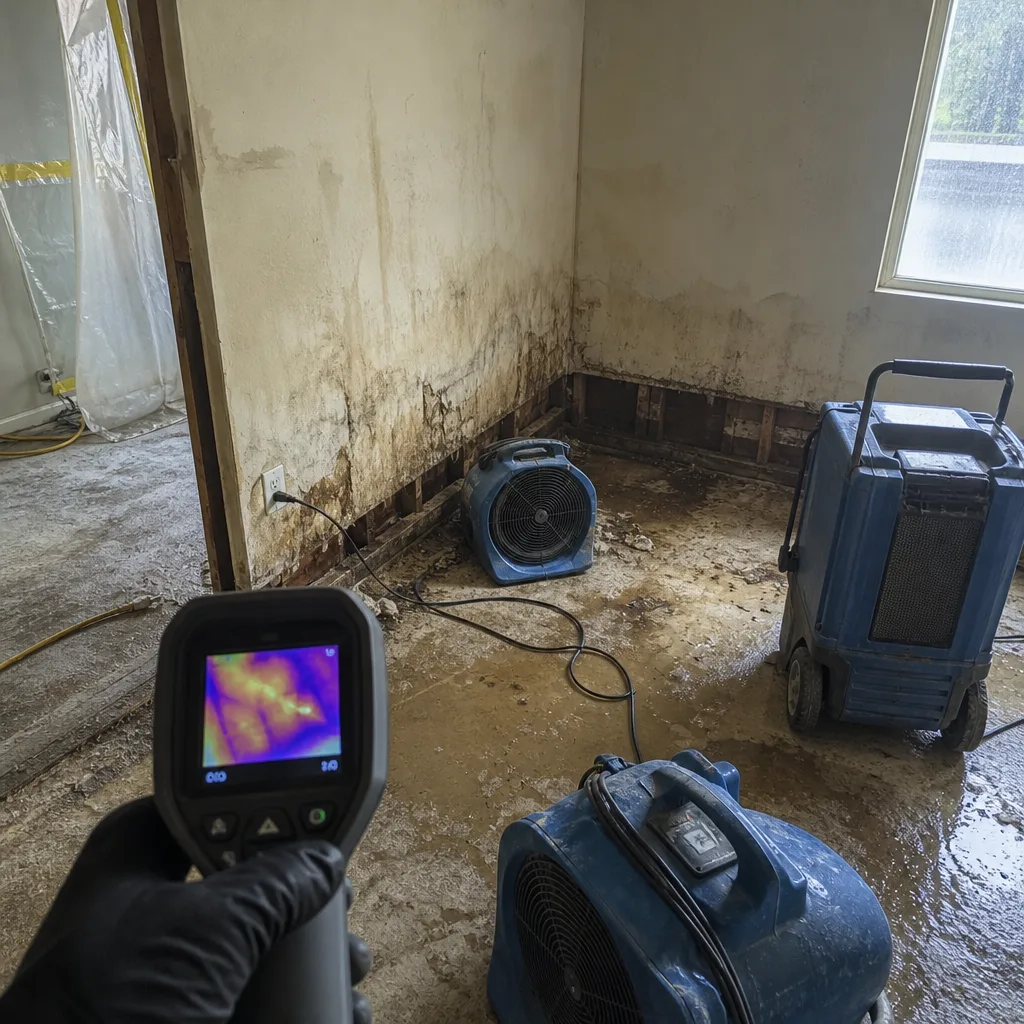
- The water category. Restoration companies classify water by contamination level per IICRC standards. Category 1 is clean water from a supply line, sink faucet, or water heater. Category 2 is gray water from a washing machine, dishwasher, or sump pump, and it contains chemical or biological contaminants. Category 3 is black water from a toilet overflow, sewer backup, or standing water that has been sitting long enough to breed bacteria. This classification determines the PPE the crew brings, the level of containment required, and whether building materials get dried or removed.
- How long the water has been present. “Just happened 10 minutes ago” versus “we came home from a weekend trip and the basement has two inches” changes the scope dramatically. Water present for more than 48 hours means certain materials are no longer salvageable and mold growth is probable. This determines whether you need a drying team or a full remediation team with containment.
- What materials are wet. Hardwood, carpet, laminate, tile, drywall, insulation, and structural framing each require different drying approaches. A carpet-over-slab situation in a Buena Park rancher dries differently than a two-story with hardwood over a wood subfloor. Knowing the materials tells the team which equipment to load: air movers, dehumidifiers, injection-drying systems, or extraction tools.
- Whether power and water are still on. If the water is still flowing, the dispatcher will tell you to shut it off before the crew arrives. If power is still on and there’s any chance of electrical contact, you’ll be told to cut the breaker. The crew needs to know if they’re walking into a live electrical hazard or a contained water event.
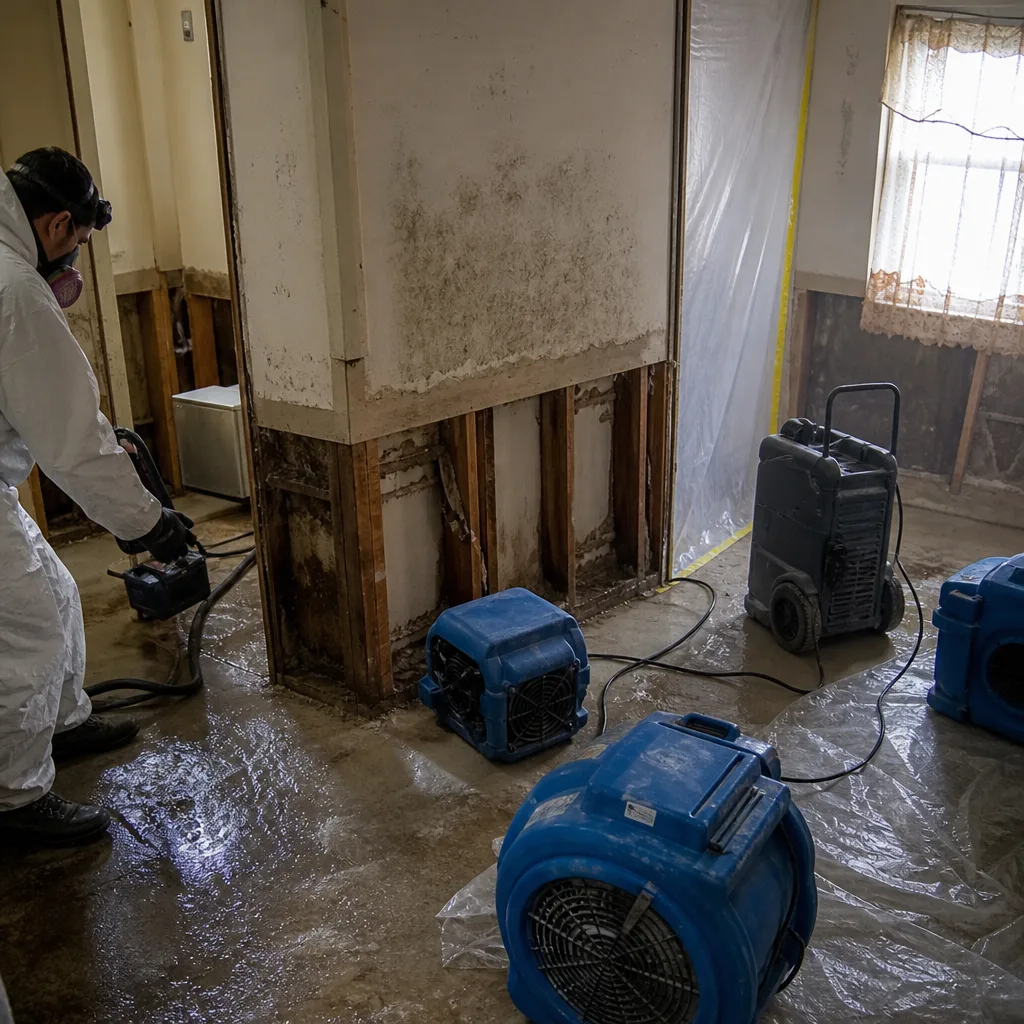
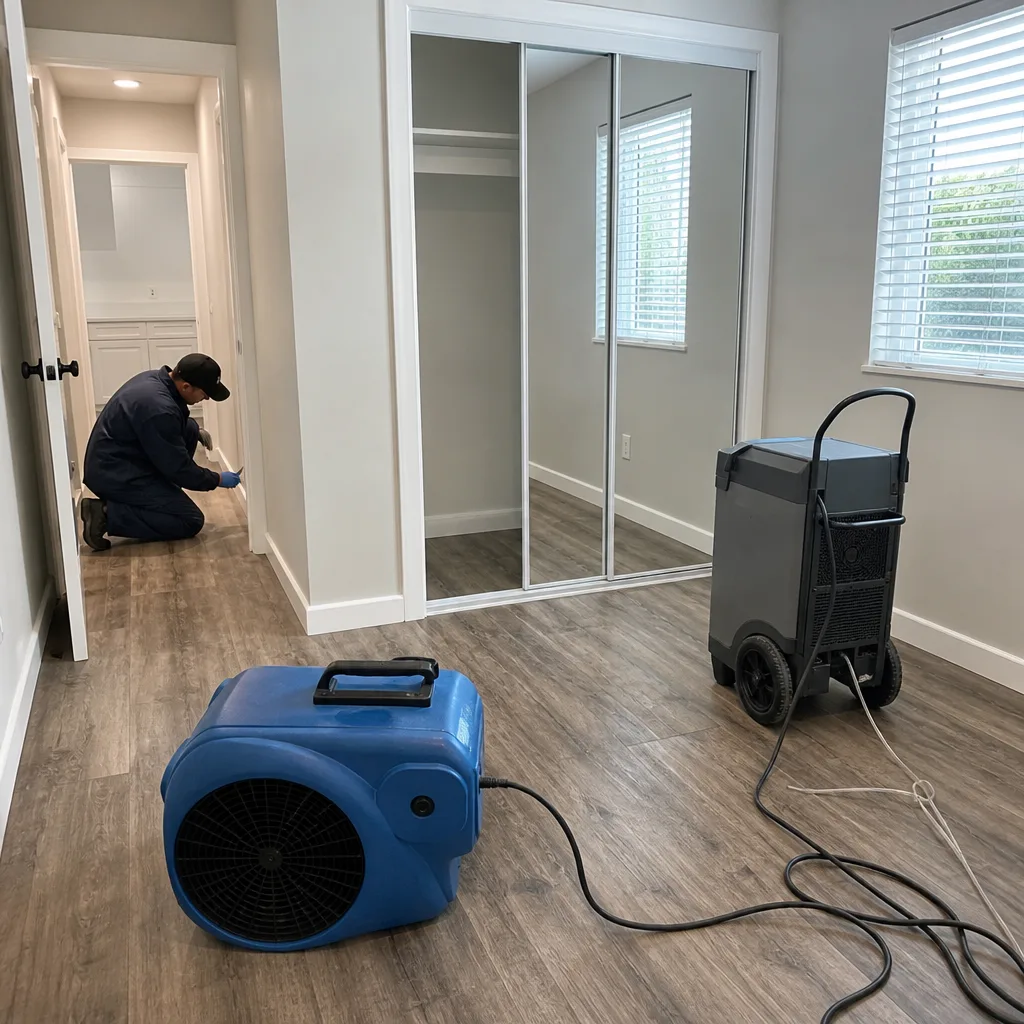
Tell the dispatcher you need a team that works to IICRC standards and uses commercial-grade drying equipment, not rental-store fans. The difference in equipment quality is the difference between a home that dries completely in three days and a home that looks dry on the surface but is growing mold behind the baseboards in three weeks. Stonecrest Water Damage crews run Dri-Eaz, Phoenix, and XPOWER systems on every job, which means the equipment arrives calibrated for structural drying, not spot-drying a small puddle.
Why Buena Park Homes Face Specific Water Damage Risks
Buena Park sits in a region where homes face a specific intersection of age, construction style, and climate that influences water damage risk. Understanding these local factors helps homeowners know what to watch for and where to focus their preparedness efforts.
Slab foundations and copper pipe aging. Most Buena Park single-family homes were built between 1950 and 1980, and a large percentage sit on concrete slab foundations. Copper supply lines run through or under the slab, and after 40 to 60 years, pinhole leaks and burst sections become increasingly common. Leaks under a slab don’t present as dramatic flooding. They present as a warm spot on the floor, running water sound with no visible source, or rising water bills. By the time you see water, the slab has been eroding for weeks or months.
Seasonal rain and drainage. Buena Park gets most of its rainfall between December and March, and heavy rain events can overwhelm older drainage systems. Homes built before current grading codes often have inadequate slope away from the foundation, leading to water pooling against the slab during sustained rain. Once water saturates the soil around a foundation, hydrostatic pressure can push moisture through hairline cracks and into the structure. The damage is slow, persistent, and often mistaken for a plumbing leak.
Older water heaters and standard supply lines. Water heaters in Buena Park homes frequently live in garages, which means failures there can flood the garage, damage stored contents, and seep into shared walls with living spaces. Standard rubber-braided washing machine hoses are another failure point we see regularly. The rubber degrades, the braided covering masks the failure until it bursts, and the result is 6 to 10 gallons per minute dumping onto the laundry room floor.
Flat and low-slope roof sections. Many Buena Park homes have flat or low-slope roof areas over additions, patios, or garages. These sections collect water and debris that can back up under the roofing material during heavy rain, leading to ceiling leaks and drywall saturation. The water may not show up in the living space until the leak has been active for days or weeks.
The takeaway: Buena Park water damage is not just burst pipes. It’s slow leaks under slabs, saturation from seasonal drainage, roof edge leaks, and aging mechanical failures. Your preparedness should account for all of them, not just the dramatic pipe burst.
What Actually Belongs in a Water Damage Emergency Kit
Most emergency kit advice tells you to stock bottled water and canned food, which is useful for earthquakes but useless for a burst pipe at 2 a.m. Here’s what a water damage emergency kit actually contains, and why each item earns its place:
- Meter key or curb key. For turning off the street-level shutoff if the house main is inaccessible. $15 to $25 at any Buena Park hardware store. Without it, you’re trying to improvise with channel locks in the dark.
- Heavy-duty flashlight or headlamp. The water event will happen in a dark crawl space, a dim garage, or a power-outage situation. A headlamp keeps both hands free. Check the batteries quarterly.
- Dry/wet vacuum. A 5 to 10-gallon wet/dry vac handles the first pass of standing water extraction and pays for itself on the first use. A $100 unit can remove 10 to 20 gallons of water before the restoration team arrives.
- Water alarm sensors. Small battery-powered sensors placed under sinks, near water heaters, behind washing machines, and in sump pits sound an audible alarm when moisture is detected. Place them now, replace the batteries annually. They cost under $15 each and catch leaks before they become floods.
- Printed shutoff map and triage sequence. Laminated or taped inside a cabinet door. Your phone might be dead or in another room. Paper works.
- Restoration company phone number. Written on the printed triage sheet. Don’t rely on Googling “water damage restoration Buena Park” while water is spreading. Have the number already written down, and know that the company you’re calling runs certified crews with commercial-grade equipment.
- Old towels and a tarp. For dam building, absorption, and protecting furniture. Keep a stash in the garage, not the linen closet where they’ll be unreachable if the leak is between you and them.
None of this is expensive. The total cost is under $200, and 90% of it gets used the first time you need it. The most valuable item in the kit is the printed shutoff map and triage sequence, because that’s what eliminates the confusion window that turns a manageable leak into a structural loss.
Common Mistakes to Avoid
- Waiting to see if it dries on its own. Drywall, subflooring, and insulation do not dry on their own in Buena Park’s coastal air. They stay damp, and within 24 to 48 hours, mold colonization begins. By the time you can smell it, the colony is established.
- Using rental-store fans and dehumidifiers. Big-box rental equipment is designed for light-duty deodorizing and spot drying. It cannot match the air movement cubic feet per minute or the water removal capacity of the commercial-grade Dri-Eaz, Phoenix, or XPOWER systems used by restoration professionals. You’ll pay rental fees for equipment that can’t do the job, and the structure stays wet.
- Ripping out wet drywall or carpet before documenting everything. Insurance adjusters need to see the damage before you start tearing things out. Take photos and video of every wet surface, then call your restoration company and insurance provider. Professional crews document the loss before they start work, and they know what the insurer requires.
- Not cutting the power when you should. Electricity and water combine into a fatal hazard faster than most people process. If there’s any doubt, cut the breaker. The inconvenience is nothing compared to the risk.
- Assuming the water didn’t travel far. Water follows gravity, capillary action, and the path of least resistance. A leak in a second-floor bathroom travels through the subfloor, into the ceiling cavity, down wall studs, and into the room below. What looks like a contained puddle may have already saturated three structural assemblies.
- Not locating the main shutoff until an emergency happens. Reading about the shutoff location is not the same as finding it, turning it, and labeling it. Your future self is not smarter or calmer than your current self. The time to locate and test the valve is now.
- Calling a general contractor instead of a restoration company. General contractors patch surfaces. Restoration companies extract water, dry structures to measurable moisture content, and remediate microbial growth to IICRC standards. The wrong call means the surface gets fixed and the moisture stays in the walls.
When to Call a Professional
Call a restoration professional when water intrusion affects more than a small area you can fully dry within a few hours, when water has contacted drywall, insulation, subflooring, or structural framing, when the water is gray or black water, or when the source was a ceiling leak, slab leak, or sewer backup. These situations require commercial extraction, structural drying, and moisture documentation that homeowner-grade equipment cannot provide. If there is any risk of mold growth, hidden moisture, or electrical contact, do not attempt DIY remediation. Stonecrest Water Damage offers free estimates in Buena Park. Call (833) 589-9161 and a certified team will assess the scope, document the damage for your insurance claim, and start extraction before the water spreads further.
Frequently Asked Questions
Permanent damage begins within hours, not days. Drywall starts wicking moisture immediately and loses structural integrity within 24 to 48 hours. Hardwood flooring begins cupping and warping within 24 hours of saturation. Mold spores, which are always present in indoor air, begin colonizing on wet organic materials like drywall paper and wood subflooring within 24 to 48 hours. In Buena Park’s mild, humid coastal climate, this timeline holds year-round. The faster extraction and drying begin, the more materials can be saved. Call (833) 589-9161 for guidance on your specific situation.
On most Buena Park homes, the main water shutoff is either where the water line enters the house at the front wall facing the street, in the garage near the water heater, or in an exterior utility closet on older ranches. The street-level shutoff is in a meter box at the property line near the curb, accessible with a meter key. If you haven’t located and tested both, do it this weekend. This is the single most important preparation step in this entire guide.
Most standard homeowners policies cover sudden and accidental water damage from burst pipes, supply line failures, appliance overflows, and storm-related roof leaks. They typically do not cover gradual leaks, lack of maintenance, or flood damage from rising groundwater or overflow creeks. The key to a covered claim is documentation: photos of the damage, photos of the source, and a restoration company that documents the entire extraction and drying process to IICRC standards. For details on local requirements, see Damage Restoration Permits, Codes & Inspections in CA: What You Need to Know. Insurers accept claims faster when the work is verifiable and follows industry standards.
A restoration company specializes in extraction, structural drying, and microbial remediation using commercial-grade equipment and IICRC-certified processes. A general contractor repairs and rebuilds after the damage is dried and stabilized. The restoration company removes the water that the contractor can’t see. Calling a general contractor first for water damage often results in cosmetic repairs over a still-wet structure, which leads to mold growth, material failure, and a denied insurance claim. Stonecrest handles water, mold, and fire damage under one certified team, so the full scope gets addressed without gaps between separate contractors.
Most structural drying projects take 3 to 5 days when commercial-grade equipment is used and the response is same-day. Larger losses, multiple affected rooms, or water that has been present for more than 24 hours can extend drying to 7 days or more. The process is not complete until moisture readings show the affected materials at their dry standard, typically measured with penetrating and non-penetrating moisture meters. Any company that promises a home is fully dry in 24 hours is either not measuring or not telling you the truth.
Do not disturb the mold. Disturbing mold spreads spores through the air and into unaffected areas of the home. Close off the affected room if possible, turn off any HVAC system that could circulate air from the affected area to the rest of the house, and call a certified mold remediation team immediately. Mold remediation requires containment, negative air pressure, HEPA filtration, and proper disposal of contaminated materials, all of which require professional equipment and training. Call (833) 589-9161 for a free assessment if you’ve found mold during a water event.
The Bottom Line
Water damage emergency preparedness for a Buena Park home comes down to one principle: make the decisions now so you don’t have to make them in the 20 minutes after a pipe bursts. Locate and label every shutoff in your home. Document your property with photographs and video before anything happens. Print the triage sequence and post it where you’ll see it. Know when to kill the power. Know what to tell the restoration company when you call. And have the number for a certified team written down, not something you have to search for while water spreads through your walls. The $200 and 90 minutes you spend on this now is the difference between a contained incident and a structural loss. Explore more guides & resources to stay prepared.
Written by the team at Stonecrest Water Damage, serving Buena Park since 2013. Our technicians are certified to IICRC standards, affiliated with RIA and IFA, and work with commercial-grade equipment from Dri-Eaz, Phoenix, XPOWER, B-Air, and Injectidry on every job. For more on our services, visit the Stonecrest Water Damage home page, Mold Remediation in Brea, or Fire Damage Restoration in Brea.
See the difference
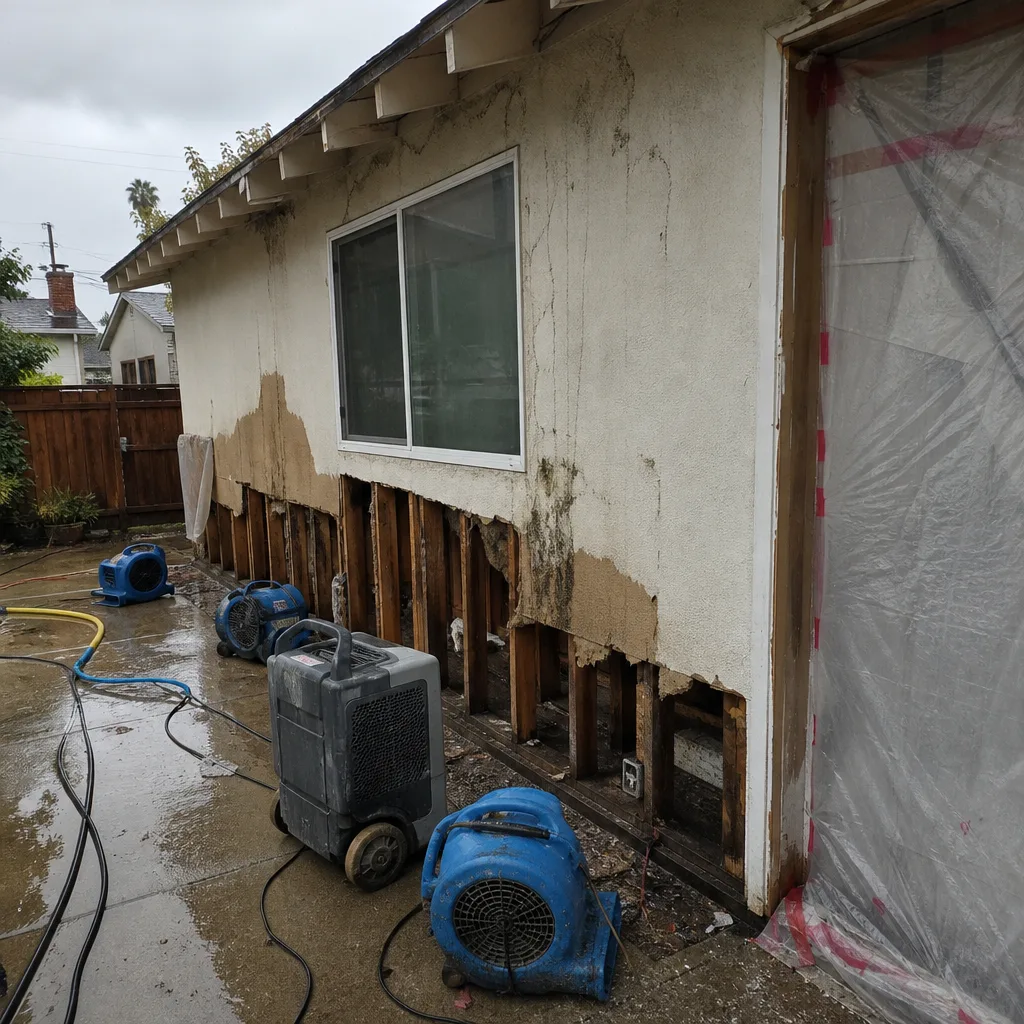 Before
 After
 Before
 After
 Before
 After