
Last updated October 31, 2026
 Water damage drying
 Fire & smoke cleanup
 Mold remediation
 Storm response
 Sewage cleanup
 Reconstruction
Free visual inspection and a written scope of work before any mitigation begins - photos, moisture readings, and drying logs go in your claim file
The scope we write is the scope we bill. Anything new gets shown to you, in writing, before we touch it.
Get your free estimateThe Complete Water Damage Restoration Guide for Buena Park Homeowners
A shop vac and a couple of box fans can pull standing water off a Buena Park living room floor in an afternoon. What they cannot do is extract the water that has already wicked up the drywall, seeped under the baseboards, and saturated the bottom plates of your interior walls. That residual moisture is where the real damage happens, and in Buena Park’s climate, it lingers longer than most homeowners realize. This guide walks you through the full technical process of Water Damage Restoration, from the initial Category classification to the final moisture readings, so you know what a legitimate restoration job looks like before you sign anything.
Quick Answer
For a deeper look at what drives pricing, see our Damage Restoration Cost Breakdown: The Buena Park Homeowner’s Reference for 2026. Water damage restoration in Buena Park follows the ANSI/IICRC S500 standard: extract standing water, classify the water by contamination level (Category 1, 2, or 3), remove unsalvageable materials, dry the structure with commercial-grade equipment over 3 to 5 days, and verify results with moisture meters and psychrometric readings. A proper restoration is not a cleaning job, it is a structural drying project, and the difference determines whether your home passes a post-restoration inspection or fails it months later when mold appears inside your walls.
Restoration work we handle
Table of Contents
- Understanding Water Categories: Why the Source Changes Everything
- Why Buena Park’s Mediterranean Climate Deceives Homeowners
- The Equipment Hierarchy: What Commercial-Grade Actually Means
- The Restoration Process: Step by Step
- The Drying Log: Your Insurance Dispute Shield
- Reading a Psychrometric Report: Verify Before You Sign Off
- Insurance and Documentation: What Adjusters Actually Look For
- The 72-Hour Mold Window in Buena Park Conditions
Understanding Water Categories: Why the Source Changes Everything
The first thing a certified technician does after arrival is classify the water. This is not paperwork. It determines what gets torn out, what can be dried in place, and what sanitation protocols apply. Under the IICRC S500 standard, water falls into three categories.
Category 1: Clean Water
This water comes from a sanitary source like a broken supply line under a sink, a failed water heater tank (yes, still Category 1), or an overflowing bathtub. In Buena Park homes built in the 1950s and 60s, we frequently see Category 1 losses from original galvanized supply pipes that have finally corroded through. Category 1 water can be dried in place if the response time is fast and materials like drywall and carpet have not been saturated for more than 48 hours.
Category 2: Gray Water
Gray water contains significant chemical or biological contamination. This includes washing machine discharge, dishwasher overflow, and toilet overflows with no solid waste. Buena Park’s older neighborhoods off Beach Boulevard and Stanton Avenue tend to have laundry rooms on the first floor over wood-framed subfloors, which means gray water migrates downward quickly. Category 2 typically requires removal of carpet pad, aggressive drying, and antimicrobial application on affected framing.
Category 3: Black Water
Black water is grossly contaminated: sewage backups, flood water from the San Gabriel River spillover, or standing water that has sat long enough to support bacterial growth. In Category 3, the demo threshold changes entirely. Drywall below the flood line, carpet, pad, and often baseboards come out. No legitimate restoration company will try to dry Category 3 materials in place. The goal is contamination removal first, drying second.
We have walked into Buena Park homes where a homeowner spent two days shop-vaccing Category 3 water from a sewer line backup, thinking they were handling it. The visible water was gone. The drywall two feet up the wall was still holding bacteria. That wall needed to come out, and any delay just pushed contamination deeper into the structure.
Why Buena Park’s Mediterranean Climate Deceives Homeowners
Buena Park gets roughly 14 inches of rain per year, almost all of it between November and March. The rest of the year, relative humidity sits between 50 and 70 percent near the coast. From a drying standpoint, that number matters more than the rain.
Here is what homeowners miss: ambient humidity in Buena Park often drops into the 40 percent range during afternoon heat, which makes building materials feel dry to the touch. But wood framing, drywall, and plaster retain moisture at the molecular level far longer than surface touch suggests. A wall cavity at 25 percent moisture content can feel dry on the painted surface. That cavity is still a mold factory waiting for the right temperature cycle.
Buena Park’s temperature swings compound the problem. Daytime highs in the 80s and nighttime lows in the 50s create condensation cycles inside unsealed wall cavities. Moisture that would evaporate in a drier climate like Phoenix instead cycles between vapor and liquid inside your walls. This is why drying targets in Buena Park are set by actual moisture measurements, not by elapsed time or surface feel.
The practical takeaway: if a contractor tells you the walls “feel dry” without showing you a moisture meter reading, they have not actually verified anything. In Buena Park conditions, that is an invitation to a mold problem you will not see until it has colonized the back side of your drywall.
The Equipment Hierarchy: What Commercial-Grade Actually Means
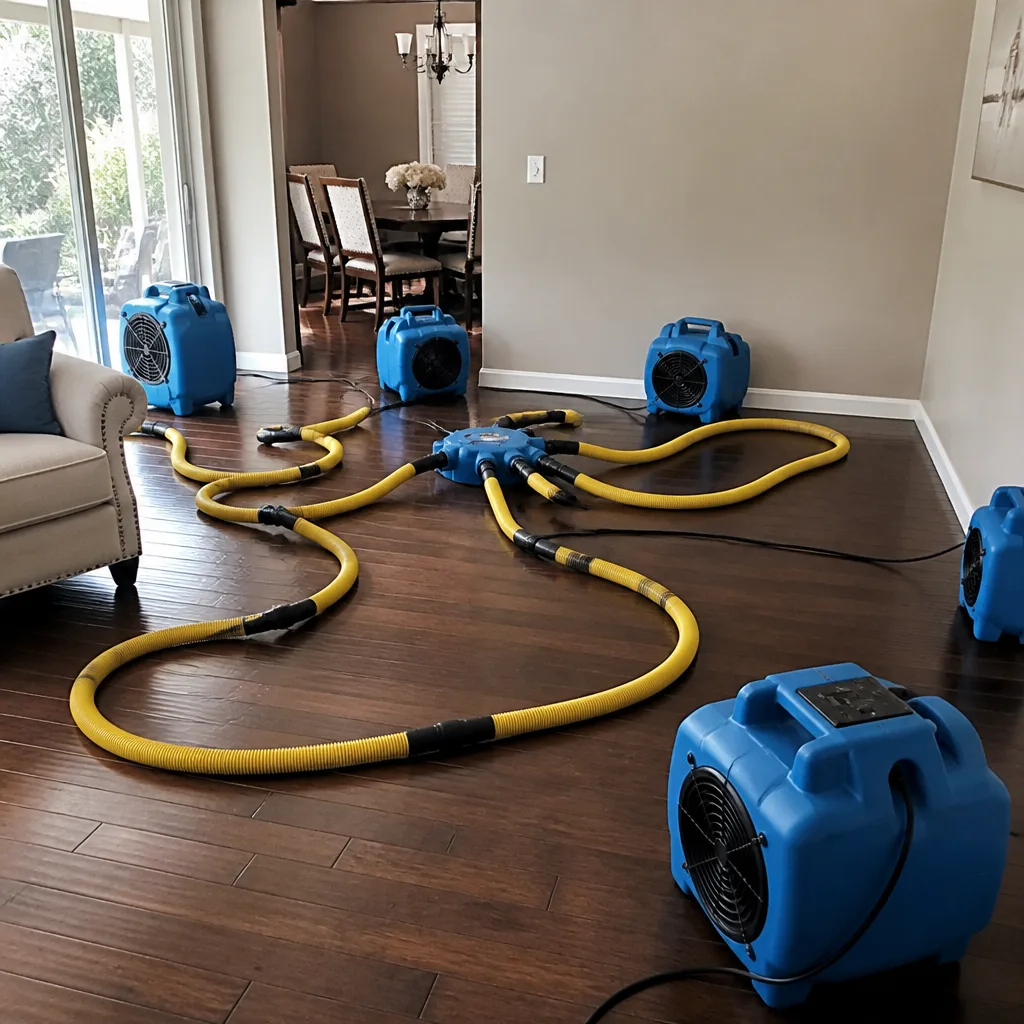
Most homeowners have seen the rental machines at big-box stores. Blue blowers, a small dehumidifier with a collection bucket, maybe a carpet fan. Those tools have their place for damp carpets and minor spills. They are not restoration equipment.
Restoration-grade drying uses equipment from manufacturers like Dri-Eaz, Phoenix, and XPOWER, the same systems deployed on large commercial loss sites across Southern California. The difference is not branding. It is engineering output.
Refrigerant Dehumidifiers
Refrigerant dehumidifiers work by pulling air across cold coils, condensing moisture out of the air. They perform well in warm, humid conditions. That makes them a solid fit for many Buena Park water losses between May and October, when indoor temperatures are comfortable and relative humidity is elevated. On a typical Category 1 kitchen supply line break, two Phoenix or Dri-Eaz refrigerant dehumidifiers and four to six high-velocity air movers create a drying envelope that hits drying targets in 72 to 96 hours.
Desiccant Dehumidifiers
Desiccant dehumidifiers use a rotating silica gel wheel to chemically strip moisture from the air. They produce extremely dry air, down to single-digit grains per pound. Buena Park homes with plaster walls, dense hardwood, or structural cavities that cannot be fully opened benefit from desiccant drying because the dry air penetrates deeper without requiring demo. Desiccant units also work well in cooler spaces like garages and under-structure crawl spaces during Buena Park’s winter months.
We use both types depending on the building material and the psychrometric readings. The point is that the equipment selection is a technical decision, not a matter of what happens to be on the truck that day.
Injectidry and In-Wall Drying
One tool that separates structural restoration from demolition-heavy general contracting is the Injectidry system. It forces dry air directly into wall cavities through small holes drilled behind baseboards, under cabinets, or through the wallboard itself. Instead of tearing out drywall to dry the framing behind it, technicians can dry the cavity in place. That means less demo, shorter reconstruction time, and more of the original structure left intact.
In a 1960s Buena Park ranch house with original wood paneling, Injectidry is often the difference between a three-day drying project and a two-week tear-out. The technology exists to preserve building materials, but only if the technician knows how to use it. This is where certifications matter.
Restoration companies certified to IICRC standards are trained specifically in the S500 water damage and S520 mold remediation protocols that govern equipment selection, drying goal calculation, and documentation. Membership in organizations like the Restoration Industry Association reinforces that training with trade-level accountability. When you hire a certified team, you are hiring a documented process, not a guess.
The Restoration Process: Step by Step
For advance planning, read our Damage Restoration Emergency Preparedness Guide for Buena Park Homes. Here is what a compliant water damage restoration looks like from the first call to the final reading. This is the sequence we follow on every Buena Park job, and it aligns with the IICRC S500 standard.
- Inspection and classification. The technician identifies the water source, stops it if it is still active, classifies the water Category, and maps the affected area. This includes checking adjacent rooms and the space below the floor. Water travels laterally through subfloor and framing, so the visible stain is rarely the full extent of the damage.
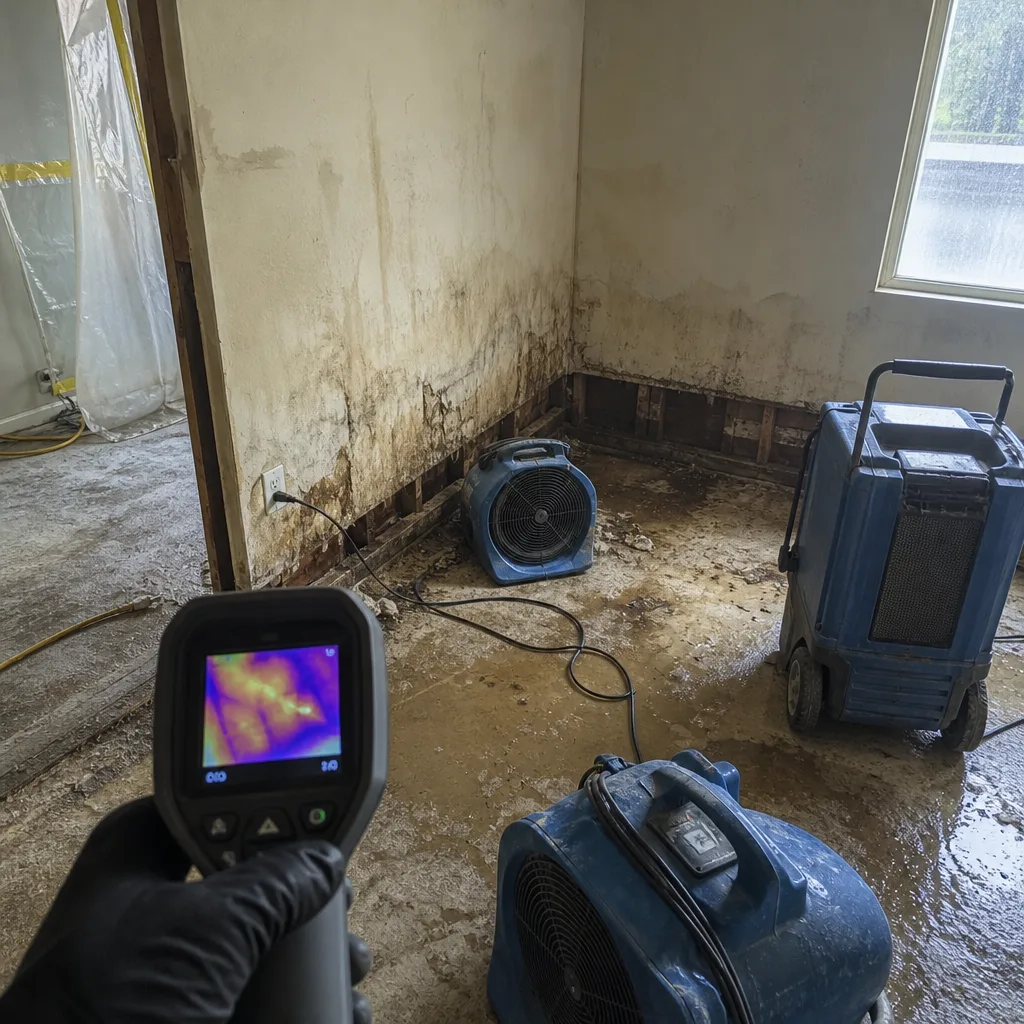
- Moisture mapping. Using penetrating and non-penetrating moisture meters, the technician maps readings across all affected materials: drywall, baseboards, subfloor, framing, and trim. Every reading is logged. These baseline numbers are the starting point for the drying plan.
- Extraction. Standing water comes out with truck-mounted or portable extraction units. For deep saturation in carpet, a weighted extraction tool pulls water from the pad and subfloor, not just the carpet fibers. This step removes the most water by volume, and doing it correctly cuts days off the drying time.
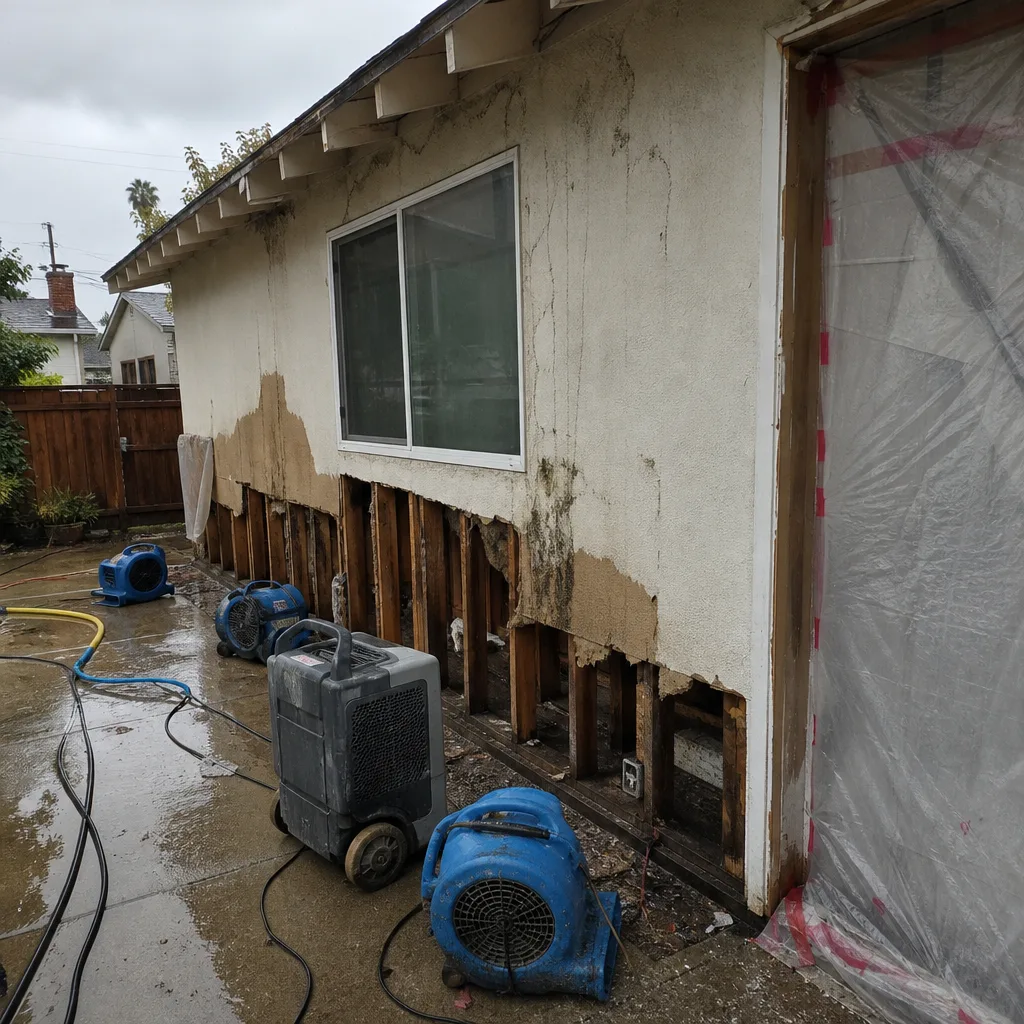
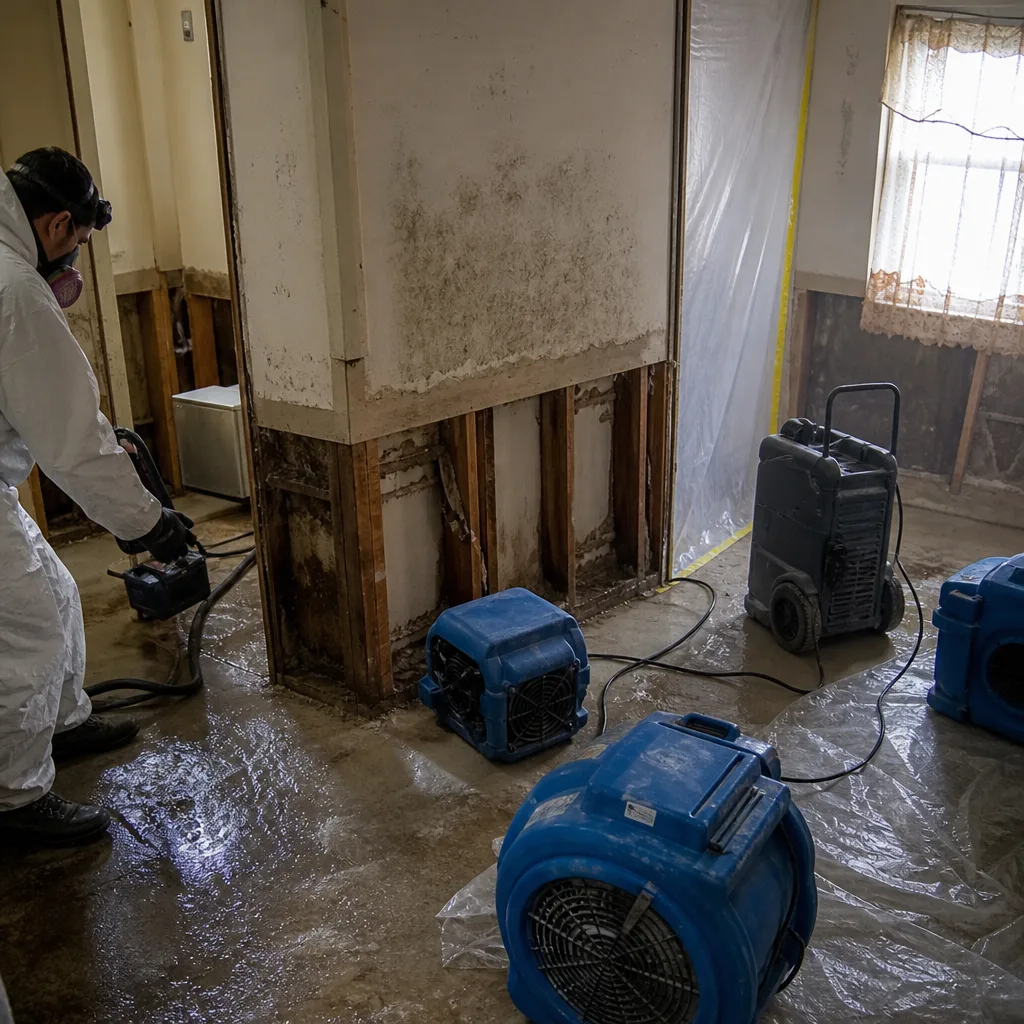
- Selective demolition. Material that cannot be dried is removed: saturated drywall below the water line, delaminated carpet pad, compressed insulation, and any Category 3 affected porous material. In Buena Park homes with original plaster, we go to significant lengths to preserve it because replacing plaster with modern drywall changes the character of the home.
- Equipment placement. Air movers are positioned to create a circular airflow pattern across all wet surfaces. Dehumidifiers are sized to the cubic footage of the affected space. Each unit is logged with its model number, capacity rating, and placement location.
- Daily monitoring. The technician returns daily or every other day to re-measure moisture levels at the same points as the initial mapping. Drying goals are calculated per material: drywall should return to its baseline moisture content, typically 4 to 12 percent depending on the material, and wood framing should drop below 16 percent moisture content. Each visit generates new readings added to the drying log.
- Final clearance. When all materials hit their drying goals, the technician takes final readings and documents them against the baseline. The equipment comes out. If any material has not reached goal after five days, the drying plan gets adjusted, not abandoned. A contractor who pulls equipment early is leaving moisture behind.
Some homeowners ask whether they can just run their home HVAC fan and open windows. In Buena Park, with daytime humidity levels that swing wide, the answer is almost always no. An HVAC fan moves air but does not dehumidify. Open windows introduce uncontrolled humidity. The drying equation requires controlled air movement and controlled humidity extraction simultaneously.
The Drying Log: Your Insurance Dispute Shield
If your restoration ever goes to an insurance dispute, the single most important document is the drying log. Not photos. Not the technician’s testimony. The log.
A compliant drying log contains dated, time-stamped moisture readings for every affected material, from the baseline mapping through final clearance. Each entry identifies the material, its location, the moisture meter used, the reading taken, and the drying goal for that material. The log also records equipment placed, when it was placed, and when it was removed.
Why does this matter? Insurance claims for water damage in Buena Park, like most of Orange County, often involve a second opinion from an independent adjuster or a third-party inspector. If a contractor completed a dry-out but cannot produce a drying log, the insurance company has no verifiable evidence that the work was done to standard. The homeowner is left arguing, “The contractor said it was dry,” against an adjuster who says, “Prove it.”
The Water Damage Restoration in Brea process we follow produces a drying log on every job because the documentation is not optional extras. It is the verification that the work was actually done. IICRC S500-compliant drying is, at its core, a measurable standard. If you cannot measure it, you did not dry it.
Reading a Psychrometric Report: Verify Before You Sign Off
Before a contractor asks you to sign off on a completed dry-out, ask for the final psychrometric readings. Here is what you are looking at.
A psychrometric report measures the relationship between temperature, relative humidity, and specific humidity (grains per pound of dry air) in the affected environment. During drying, the goal is to bring the specific humidity of the air in the affected space down to match or beat the specific humidity in the unaffected portions of your home. If the affected space still holds more atmospheric moisture than the rest of the house, drying is not complete.
Three numbers matter most:
- Relative humidity (RH) in the affected space should typically fall between 30 and 50 percent during active drying. Higher RH means the air is not pulling moisture from materials efficiently.
- Grains per pound (GPP) should trend downward daily. A flat line across three consecutive days means the drying plan is stalled.
- Material moisture content is the ground truth. Wood framing should read below 16 percent. Drywall should return to its pre-loss baseline, generally under 10 to 12 percent. Any material that still reads high while the air in the room appears dry is trapped moisture inside the material itself.
One common scenario in Buena Park: the air in the room reaches a good RH, and the technician declares the job done. But the framing inside a wall, particularly a shared wall between the garage and living space, still reads 20 percent moisture content because that cavity never got direct airflow. That is a job that is not finished, and it will announce itself later as a musty odor or a mold bloom behind the baseboard. The psychrometric report is how you catch that before the contractor leaves.
Insurance and Documentation: What Adjusters Actually Look For
Most Buena Park homeowners file a water damage claim with their homeowners insurance. The adjuster’s job is not to deny your claim. It is to verify that the damage exists, that the restoration scope is warranted, and that the work performed matches the price being charged. Documentation makes that verification possible.
Adjusters look for three things in a water damage file: a photo-documented assessment, a category classification with rationale, and a drying log that shows progress from saturated to dry. Without those, the claim stalls. With them, the claim moves.
You should also know that your restoration company can speak directly with your adjuster. This is not a conflict of interest; it is standard practice in the restoration industry. When technicians and adjusters operate from the same IICRC standard, the negotiation is technical, not emotional. The drying log is the common language.
For Buena Park homeowners with older homes, there is one additional consideration. Many local houses were built before modern building codes required moisture barriers under slab foundations. Water that wicks up through an unsealed slab during a supply line break can saturate the bottom plates of interior walls. That type of hidden damage requires moisture mapping and cavitation drying, and it is exactly why measured documentation matters. You cannot photo-document moisture you cannot see.
The 72-Hour Mold Window in Buena Park Conditions
Mold spores are everywhere. They sit dormant, waiting for moisture and a food source. Your drywall paper, wood framing, and carpet pad are all food sources. In Buena Park’s temperature range, mold can begin colonizing wet materials within 48 to 72 hours. That timeline is not a worst case scenario; it is the standard biological window recognized by the IICRC and most environmental health agencies.
This is why the response time on water damage is not a matter of convenience. If a supply line breaks on a Friday morning and you wait until Monday to call, you are already past the 72-hour window. That does not mean mold is guaranteed, but it means the probability curve has turned against you.
Homeowners sometimes ask whether a mold problem means they need full mold remediation or just a good cleaning. The honest answer depends on the extent of visible growth and the results of an air quality or surface sampling. What we can say from experience: mold hidden inside wall cavities does not announce itself. By the time you smell it or see staining on the baseboard, the colony has likely been growing for weeks. This is why the Mold Remediation in Brea process begins with an inspection that looks beyond the visible surface.
The connection between water damage and mold is the strongest reason to treat water extraction as the beginning of the job, not the end. A water restoration company that pulls the water and leaves the structure wet has done half a job. The mold will finish the other half for them.
Common Mistakes to Avoid
- Using a shop vac as a drying strategy. Shop vacs extract surface water. They do not remove water from drywall, subfloor, or framing. Every hour that moisture sits in those materials moves you closer to the mold window.
- Assuming a dehumidifier from the hardware store is enough. A 30-pint consumer dehumidifier lacks the airflow and capacity to pull water from building materials. It dries the air, not the structure.
- Skipping the water Category assessment. Homeowners who treat sewage backup like a clean water spill end up with contaminated drywall left in place. Category 3 water demands removal of porous materials, not drying them.
- Pulling equipment early. When the air feels dry but the materials are not at target, the job is not done. A contractor who takes the dehumidifiers out three days early has saved themselves time and left you a problem.
- Filing an insurance claim without a drying log. Insurers and independent adjusters in Buena Park expect documentation. No log, no leverage.
- Replacing drywall without addressing the framing behind it. Cosmetic rebuilds over wet framing look fine for two months. Then the mold grows through the new paint. This is what “restore, not just repair” means in practice.
See the difference
 Before
 After
 Before
 After
 Before
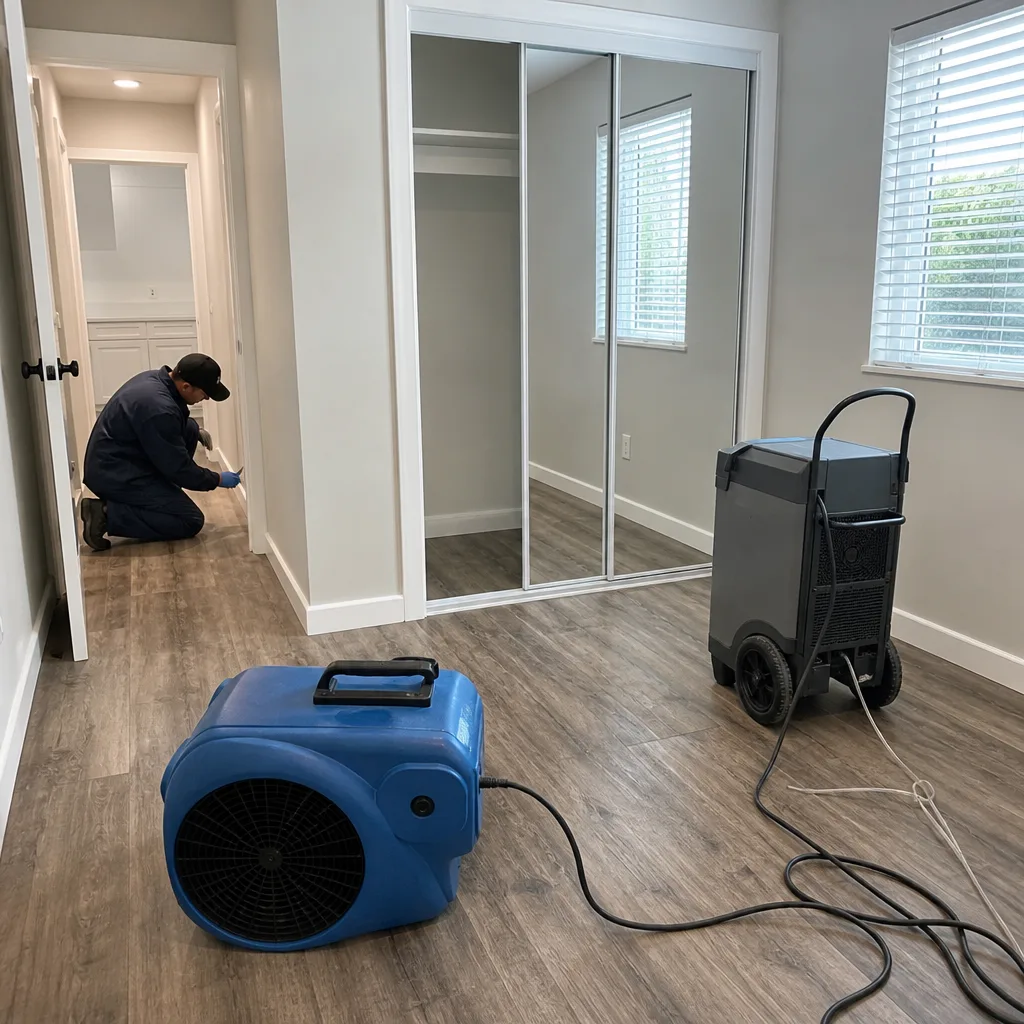 After
When to Call a Professional
Call a restoration professional the moment any of these is true: the water came from a sewage line or flood source, the affected area is larger than what you can mop up in an hour, the water has reached walls or soaked into flooring, or the water has been sitting for more than 24 hours and you cannot verify what is behind the wall or under the floor. Buena Park homeowners with slab foundations should be especially alert to water pooling under laminate flooring, where it travels laterally across the slab and saturates baseplates far from the original spill. If you are uncertain, a professional inspection costs you nothing and gives you a baseline reading on whether you have a mop-up or a rebuild. Stonecrest Water Damage offers free estimates in Buena Park for water, mold, and fire damage restoration. Call (833) 589-9161 and a certified technician will assess the full scope, including moisture mapping, before any work begins.
Frequently Asked Questions
Most residential water damage restoration projects in Buena Park take 3 to 5 days for the structural drying phase, followed by reconstruction that can run from a few days for minor drywall replacement to several weeks for flooring and cabinetry rebuilds. The drying timeline depends on the water category, the materials affected, and how quickly extraction began.
Water damage restoration in Buena Park typically ranges from $2,500 to $8,000 for extraction, drying, and selective demolition on a single-room loss, with larger multi-room or Category 3 losses running $10,000 or more before reconstruction. Your insurance coverage and the specific materials affected determine your out-of-pocket cost. Call (833) 589-9161 for a free estimate based on an actual inspection.
Most Buena Park homeowner’s policies cover sudden and accidental water damage, like a burst supply line or water heater failure, but do not cover gradual leaks or long-term seepage. The fastest way to know is to have a restoration company document the damage and classify the source, then submit that documentation with your claim. Your adjuster speaks the same IICRC documentation language, which is why proper drying logs matter.
You can remove surface water yourself, but you cannot dry wall cavities, subfloor, or framing without commercial air movers, proper dehumidification capacity, and moisture meters to verify the result. Explore our more guides & resources for additional homeowner guidance. In Buena Park’s climate, surface-dry materials often conceal hidden moisture that becomes a mold problem within weeks.
If water sat for more than 48 hours or the affected materials were not professionally dried, you should have a mold inspection even if you cannot see growth. Musty odors, discoloration on baseboards or walls, or respiratory symptoms that improve when you leave the house are all signs that hidden mold may be present.
Replacing wet drywall without drying the framing behind it leaves moisture trapped inside the wall cavity, where it will eventually grow mold behind your new drywall. Restoration means drying the entire affected structure to documented moisture standards before any rebuilding happens. That is the difference between a repair and a restoration.
The Bottom Line
Water damage in Buena Park is a structural drying problem, not a cleaning problem. The visible water is the easiest part to remove. What matters is the moisture you cannot see: inside walls, under flooring, soaked into framing. That moisture demands commercial-grade equipment, measured drying goals, and documentation that proves the work was done to standard. Certified restoration is the difference between a home that passes a post-restoration inspection and one that fails it months later. If you are dealing with water damage right now, the clock is already running. Call (833) 589-9161 for a free, documented assessment before the 72-hour mold window closes.
Written by the team at Fire Damage Restoration in Brea, serving Buena Park since 2013.